

When a solar thermal system stops heating water, most homeowners assume the whole installation has failed. In reality, solar thermal problems UK homeowners report each year almost always come down to one of a handful of predictable faults: a pump that has stopped turning, fluid that has degraded, air trapped in the pipework, or a controller that is no longer reading temperatures correctly. Each of these has a distinct set of symptoms and a proven fix.
This guide walks through the nine most common reasons a solar thermal system stops heating water, in roughly the order our engineers encounter them on site across South England. You will find the checks you can safely carry out yourself, the signs that point to a specific fault, and the point at which the job needs a qualified engineer rather than a screwdriver and good intentions.
Quick Checks Before You Call an Engineer
Before working through the causes below, it is worth ruling out the simplest explanations first. These three checks take a few minutes and resolve a surprising number of cases where a solar thermal is not working for reasons that have nothing to do with a genuine fault.
- Check the pressure gauge on the pump station. A healthy sealed system should read between 1.5 and 2.0 bar when cold. A reading at zero, or noticeably lower than usual, points straight to one of the pressure-related causes further down this list.
- Check the controller display. Confirm it is powered on and showing sensible collector and cylinder temperatures, and watch whether the pump activates when the collectors are clearly hotter than the cylinder on a sunny morning.
- Check the weather and the season honestly. A run of overcast days or the depths of a UK winter will always reduce output. This is expected behaviour, not a fault, and it is worth ruling out before assuming something has broken.
If pressure looks correct, the controller is behaving normally, and the cylinder still is not reaching temperature on a clear day, the fault is inside the system somewhere. The nine causes below cover almost every scenario our engineers are called out for.
9 Causes of a Solar Thermal System Not Heating Water
Circulation Pump Not Working
A solar thermal pump not working is one of the most common reasons a system stops contributing to hot water. The pump moves heat transfer fluid from the roof collectors down to the coil in your cylinder and back again. When it fails, the collectors can reach very high temperatures on a sunny day while the cylinder temperature stays completely flat, because the heat being generated has no way of reaching the water. A pump nearing failure sometimes makes a grinding or rattling noise before it stops altogether. Pump replacement is usually a straightforward job completed in a single visit, and it is one of the most reliable fixes available for this fault.
Low System Pressure
Solar thermal low pressure shows up as a gauge reading below the normal 1.5 to 2.0 bar range, or as pressure that keeps dropping even after being topped up. The system is a sealed, pressurised circuit, so pressure does not disappear without a reason. The usual culprits are a leak somewhere in the pipework or connections, a relief valve that has discharged, or a failed expansion vessel. Simply topping up the pressure and hoping it holds rarely works for long. The source of the loss needs tracing and fixing, otherwise you will be back to square one within weeks.
Failed Expansion Vessel
The expansion vessel absorbs the increase in fluid volume as glycol heats up and expands, and it relies on a nitrogen pre-charge that gradually loses pressure over the years. Once the pre-charge drops too low, the vessel can no longer do its job, so the pressure relief valve opens instead and discharges fluid to relieve the strain. That is often the real explanation behind a solar thermal expansion vessel failed diagnosis: repeated small pressure drops, sometimes with staining visible near the relief valve outlet. Depending on condition, the fix is either re-pressurising the vessel or replacing it, both of which are inexpensive, routine repairs.
Air Lock in the Circuit
Trapped air in the pipework or collector loop stops the heat transfer fluid circulating properly, even when the pump itself is working perfectly well. A solar thermal air lock UK engineers see most often develops after a fluid replacement, after any repair that involved draining the system, or following a period of stagnation where fluid partially vaporised in the collectors. The symptoms can look confusingly similar to a pump fault: warm collectors, cool cylinder. Clearing an air lock means purging the circuit at the correct bleed points, which is a job for an engineer with the right access and equipment.
Degraded Heat Transfer Fluid (Glycol)
The propylene glycol and water mixture that carries heat around the primary circuit does not last forever. Solar thermal glycol degraded UK systems typically show fluid that has turned dark brown or orange, has become acidic, and has lost much of its ability to transfer heat efficiently. This process accelerates in systems that regularly stagnate in summer. Beyond reduced performance, acidic glycol starts to corrode pump impellers, pipework and the heat exchanger coil from the inside. Manufacturers generally recommend testing the fluid annually and replacing it every four to five years, and a full flush and refill resolves the problem completely.
Faulty Controller or Sensor
The differential controller is the brain of the system. It compares the temperature at the collectors with the temperature at the bottom of the cylinder and switches the pump on when there is useful heat to transfer. A solar thermal controller not working correctly might run the pump when it should not, fail to run it when it should, or display a fault code or blank screen. Sometimes the controller itself has failed; sometimes it is a single sensor that has drifted out of calibration. Either way, the fix is usually a straightforward replacement completed within one visit, and it restores the correct decision-making that keeps the system efficient.
Dirty or Shaded Collectors
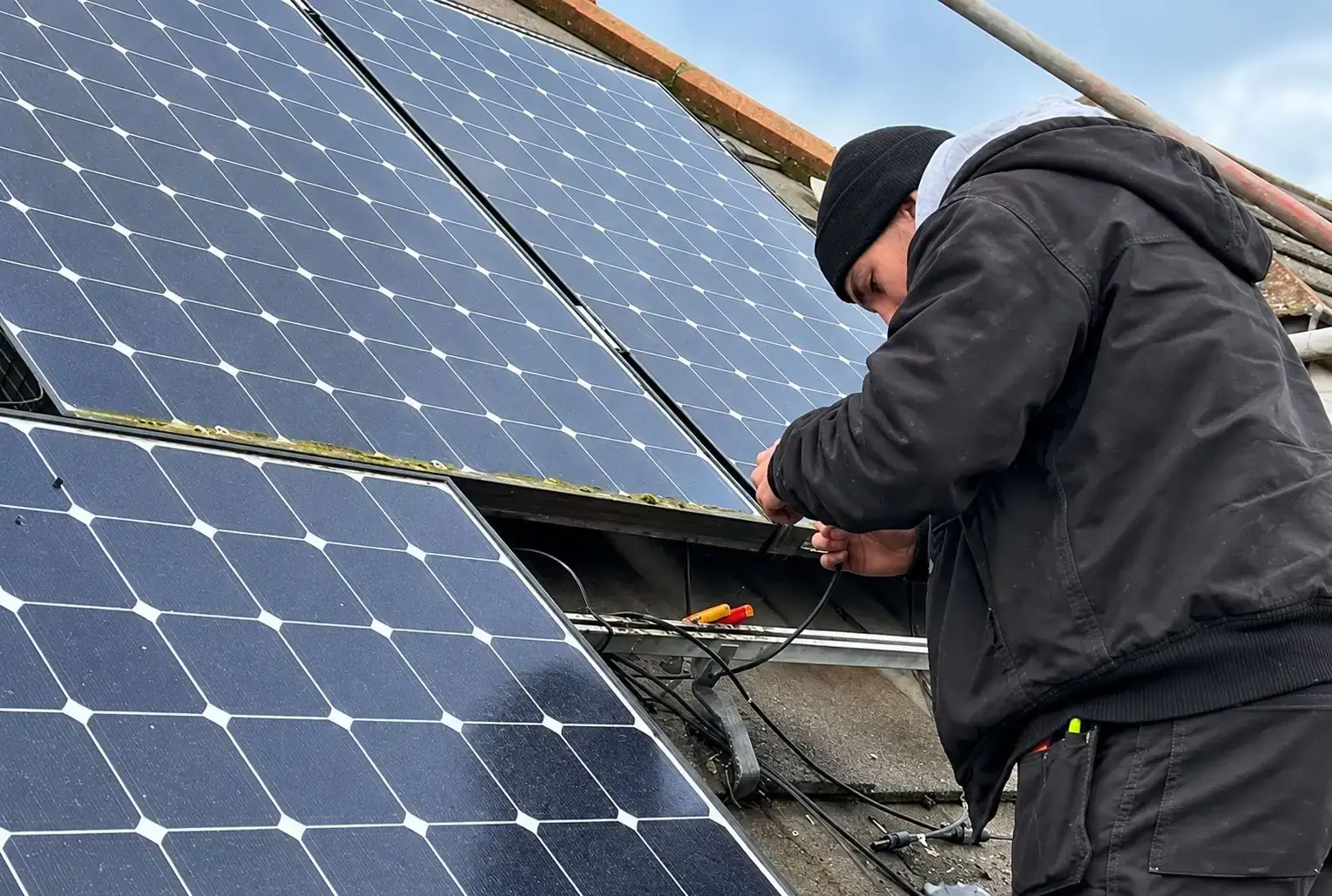
A solar thermal collector dirty from years of grime, moss, lichen or bird droppings will absorb noticeably less energy than a clean one, and the drop in performance tends to happen so gradually that it is easy to miss. New shading from tree growth, a satellite dish or a neighbouring extension can have the same effect. It is also worth watching for condensation or discolouration behind the glazing of a flat plate collector, which points to a failed seal rather than simple soiling. Collector cleaning and inspection needs proper roof access equipment, so this is not a job for a homeowner with a ladder and a hose.
Frost Damage
UK solar thermal systems are designed to cope with typical winter conditions, provided the glycol is mixed at the correct concentration for frost protection. If the fluid has degraded or been diluted without the ratio being corrected, that protection threshold rises and the system becomes vulnerable during a cold snap. Solar thermal frost damage UK engineers repair most often affects pipework, pump housings and collector manifolds, sometimes as cracked joints that only reveal themselves as a leak once temperatures rise again. Any system that has been through a hard frost is worth an inspection, even if nothing looks obviously wrong yet.
System Overheating and Stagnation
It sounds contradictory, but solar thermal overheating UK during long, bright summer days is a genuine cause of a system that later fails to heat water properly. When the cylinder is fully charged and there is nowhere for the collected heat to go, the system enters stagnation and collector temperatures can climb dramatically. Repeated stagnation cycles accelerate glycol breakdown, stress seals and joints, and can trigger the pressure relief valve to discharge. The not heating complaint that follows a hot summer is often the knock-on effect of stagnation damage rather than a separate, unrelated fault.
When You Can Troubleshoot Yourself, and When You Should Call a Specialist
Checking the pressure gauge, glancing at the controller display and listening for unusual pump noise are all reasonable things for a homeowner to do between services. Testing glycol pH and concentration, checking an expansion vessel’s pre-charge, inspecting collectors at roof level and operating a pressure relief valve all require calibrated equipment, training and safe working-at-height practice, and should not be attempted without them. If you would like a fuller picture of what a professional visit actually covers, our guide to what engineers check during a solar thermal service goes through every stage of a proper inspection in detail.
When to Call for Emergency Solar Thermal Repair
Most of the causes above can wait for a scheduled appointment. A smaller number of situations call for an emergency solar thermal repair, and should not be left even for a few days:
- Visible fluid leaking steadily from any part of the system
- A pressure relief valve that is discharging continuously rather than occasionally
- Cracked pipework or a suspected frost split, particularly after a hard freeze
- Any burning smell, discolouration or unusual noise from the pump station
If you notice any of these, switch off the pump station where it is safe to do so and get in touch straight away rather than waiting to see if it settles down on its own.
Why Choose Solar Maintenance and Repairs
Solar Maintenance And Repairs is a dedicated solar thermal engineer South England homeowners and businesses have trusted for over 20 years, and we do not treat solar thermal repair as a sideline to general heating work. Our engineers are NAPIT-registered and TrustMark-endorsed, and every job starts with an honest, itemised diagnosis before any repair work begins, so you know exactly what is wrong and what putting it right will cost. Whether the fault turns out to be a tired pump, degraded glycol or a collector that needs attention, our solar thermal repair customers rely on us because we get the diagnosis right the first time, right across Hampshire, Surrey, Kent, Dorset and the wider South England service area.
Book Your Solar Thermal Repair Today
If your solar thermal system is not heating water the way it should, the fault will not fix itself, and most of the causes above only get more expensive to put right the longer they are left. Call Solar Maintenance And Repairs on 0330 111 9399 or email info@