If you have recently moved into a property with a solar thermal system already installed, or you are trying to understand what your system actually does, this guide was written for you. A solar thermal system UK homeowners inherit is often the most misunderstood renewable technology in the home: the panels are on the roof, there is a large cylinder in the airing cupboard, and yet nobody seems to have left a manual behind. This guide covers everything you need to know, from how the system works and what each component does, through to efficiency, maintenance, and how solar thermal differs from solar PV.
Whether you are curious, concerned about performance, or preparing for your first service visit, reading this from start to finish will give you a confident, accurate picture of what you own.
What Is a Solar Thermal System?
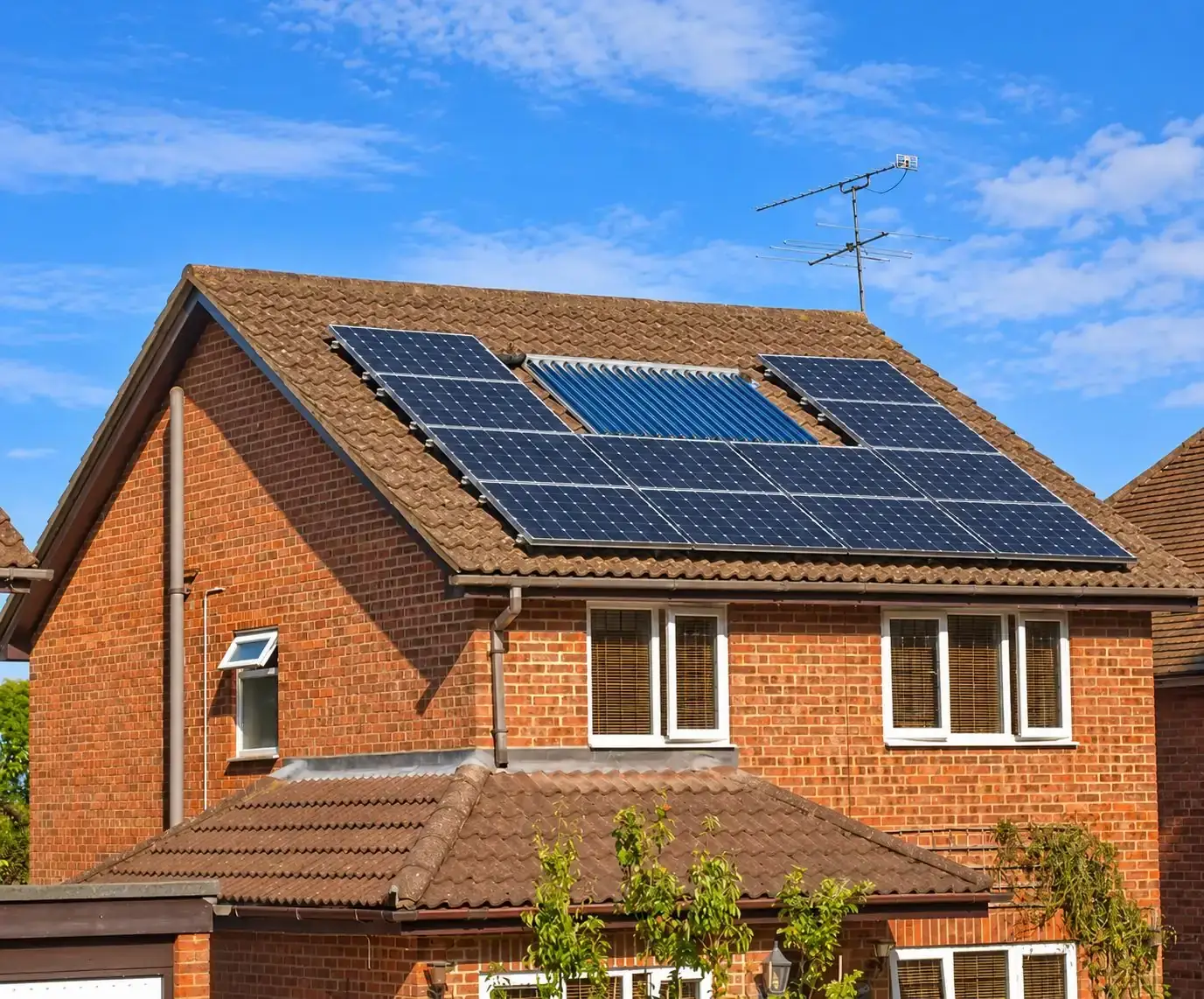
A solar thermal system is a renewable energy installation that captures heat from sunlight and uses it to warm your domestic hot water. Roof-mounted collector panels absorb solar radiation and transfer that energy, via a glycol-based fluid circulating through a closed primary circuit, to a twin-coil hot water cylinder inside your home.
A differential thermostat controller (DTC) manages the circulation pump automatically. It runs the pump when the collectors are warmer than the water at the base of the cylinder, and stops it when they are not. A conventional boiler or immersion heater acts as a backup, topping up the water temperature on overcast days or during periods of higher-than-usual demand.
A well-specified UK solar thermal system typically provides between 50 and 70 percent of a household’s annual hot water needs. Output is highest from April through September, but the system contributes usefully throughout the year, including on bright winter days.
How Does Solar Thermal Work in the UK?
Understanding how does solar thermal work starts with following the movement of energy from the roof to the hot tap. The technology is straightforward, but each stage of the process matters to overall performance.
How Does Solar Thermal Heat Water?
Here is the step-by-step process:
- Step 1: Solar collection. Sunlight strikes the collector panels on the roof. Inside the collector, a darkened absorber plate or evacuated glass tube heats up, warming the propylene glycol fluid running through it.
- Step 2: Heat transfer via the primary circuit. The warm glycol is pumped through insulated pipework from the roof, down into the property, and into the bottom coil of the solar cylinder.
- Step 3: Heat exchange to stored water. Inside the cylinder, the lower coil acts as a heat exchanger. Heat passes from the glycol fluid into the surrounding domestic water without the two fluids ever mixing.
- Step 4: Storage and backup top-up. Pre-heated water sits in the cylinder, ready for use. An upper coil connected to your boiler or immersion heater raises the temperature to 60 degrees Celsius when solar input alone is not enough.
- Step 5: Automatic control. The differential thermostat controller monitors both the collector temperature and the cylinder base temperature constantly, switching the pump on and off to ensure the system only transfers heat when it is beneficial to do so.
Does Solar Thermal Work in the UK Climate?
This is the question most homeowners ask first, and the short answer is: yes, reliably. Solar thermal collectors do not require direct sunshine. They respond to diffuse daylight, which means even overcast skies produce useful energy. The UK receives enough solar radiation year-round for a properly installed system to make a meaningful contribution to your hot water costs.
South-facing installations in Hampshire, Surrey, Dorset, and the wider South of England benefit from some of the strongest irradiance levels in the country. Systems in these areas typically sit at the upper end of the 50 to 70 percent annual hot water contribution range. Even systems in less favourable locations, or on east or west-facing roofs, continue to contribute meaningfully between spring and autumn.
Solar Thermal Components UK: What Makes Up Your System?
Every solar thermal system UK installation follows the same core architecture. Knowing what each component does will help you understand what you are looking at, spot potential problems early, and have informed conversations with your engineer.
The Solar Thermal Collector UK
The collector is the panel, or array of panels, fixed to your roof. It is the energy-capture device that starts the whole chain. There are two main types used in UK domestic installations.
Flat plate collectors. A solar thermal flat plate collector UK is the traditional and most widely installed design. It consists of an insulated metal box with a darkened absorber plate inside, copper or aluminium pipes bonded to the plate surface, and a toughened glass cover on the front. Sunlight passes through the glass, heats the absorber, and the glycol fluid flowing through the pipes carries that heat away down through the primary circuit.
Flat plate collectors are robust, cost-effective, and perform well through a British spring and summer. They are the most common type found in domestic installations completed during the 2008 to 2015 period when government incentives drove widespread uptake.
Evacuated tube collectors. A solar thermal evacuated tube UK collector uses a row of individual glass tubes. Each tube contains an inner absorber element surrounded by a vacuum. That vacuum eliminates convective heat loss almost entirely, which is why evacuated tube collectors outperform flat plate designs in colder, lower-irradiance conditions.
Evacuated tube systems reach operating temperature faster in the morning, continue producing heat on cooler days, and are often the preferred specification for new installations where efficiency and year-round output are priorities. They tend to cost more than flat plate systems but offer a stronger return in climates where diffuse light predominates.
The Solar Thermal Cylinder UK
The solar thermal cylinder UK is the hot water storage vessel at the heart of the system inside the property. In almost every UK domestic installation, this is a twin-coil solar cylinder: a tall, well-insulated tank with two separate heat exchanger coils inside it.
- Lower solar coil: This is connected to the primary circuit. Glycol fluid from the collectors passes through this coil, transferring its heat to the water surrounding it inside the cylinder.
- Upper boiler or immersion coil: Connected to the conventional boiler or immersion heater, this second coil tops up the water temperature when solar input alone has not been sufficient.
A correctly sized solar cylinder for a typical three or four-bedroom home holds between 200 and 300 litres. The cylinder must be well matched to the collector area: too small, and the system overheats in summer; too large, and the solar coil cannot raise the water temperature meaningfully.
The Solar Thermal Pump Station UK
The solar thermal pump station UK is a pre-assembled unit, usually wall-mounted near the cylinder, that contains the circulating pump, flow and return connections, isolating valves, a flow meter, a thermometer, and a non-return valve. It pushes the glycol heat-transfer fluid around the primary circuit in a continuous loop between the collector and the cylinder coil.
The pump station is the mechanical workhorse of the system. On a busy summer day, it may run for eight hours or more. Pump stations are designed for straightforward inspection and maintenance access, which is why checking pump operation and flow rates is a standard part of any service visit.
The Solar Thermal Controller UK
The solar thermal controller UK, properly called the differential thermostat controller or DTC, is the electronic brain of the system. It reads two temperature sensors continuously: one at the collector (typically on the absorber plate or primary flow pipe at roof level) and one at the base of the cylinder in the solar zone.
When the collector is warmer than the cylinder base by a set margin (typically 5 to 8 degrees Celsius), the controller switches the pump on. When that difference narrows to around 2 to 3 degrees, the pump stops. This prevents the system from running against itself, which would actually draw heat out of the cylinder on cold nights or in winter.
Modern controllers do considerably more than just run the pump. Standard features on current models include:
- Overheat protection: limits the system temperature if the cylinder reaches a safe ceiling.
- Frost protection: briefly runs the pump in near-freezing conditions to protect pipework.
- Anti-legionella function: periodically heats the cylinder to 60 degrees or above to eliminate bacteria risk.
- Energy yield monitoring: displays cumulative heat output in kilowatt-hours, allowing you to track performance over time.
Solar Thermal Glycol UK: The Heat-Transfer Fluid
Solar thermal glycol UK refers to the propylene glycol antifreeze mixture that circulates through the primary circuit. It has two critical properties that water alone cannot provide: it does not freeze (protecting the primary circuit in winter temperatures), and it has a boiling point significantly higher than water (protecting the system from steam formation during peak summer output when collector temperatures can exceed 150 degrees Celsius).
Propylene glycol is food-safe and non-toxic, which is why it is the standard choice for UK domestic solar thermal primary circuits.
The important thing to understand as a homeowner is that glycol degrades over time. It becomes gradually more acidic, loses its frost protection properties, and can begin to cause internal corrosion of the pump, pipework, and heat exchanger surfaces if left unchanged. This is not a risk that announces itself with obvious symptoms, which is why proactive glycol testing is one of the most important elements of routine solar thermal maintenance.
UK industry guidance recommends testing glycol every one to two years and replacing the fluid every five to seven years, or sooner if a test shows degradation. Skipping this is the single most common cause of expensive pump and cylinder damage in older UK solar thermal systems.
Safety Components: Expansion Vessel and Pressure Relief Valve
Because the primary circuit is a sealed loop operating at elevated temperatures, the glycol fluid expands as it heats up. Without accommodation for this expansion, pressure in the circuit would rise to dangerous levels.
The expansion vessel is a sealed container, pre-charged with nitrogen, that absorbs the volume increase as the fluid expands and contracts. The pressure relief valve is the final safeguard: if system pressure exceeds its set limit (typically 6 bar in domestic installations), the valve opens automatically and releases a small amount of fluid into a discharge pipe, reducing pressure to a safe level.
Both components should be inspected during every service visit. A failed expansion vessel is one of the more common reasons a pressure relief valve discharges repeatedly. If you notice fluid staining around the pressure relief valve outlet, this should be investigated promptly.
Solar Thermal Efficiency UK: What Affects Your System’s Output?
Understanding solar thermal efficiency UK performance means looking at the factors that influence how much heat your system extracts from available sunlight. Some are fixed at installation; others change over the life of the system.
- Roof orientation and tilt. South-facing roofs at a pitch of 30 to 50 degrees from horizontal produce the best annual output in the UK. East or west-facing orientations typically reduce output by around 15 to 20 percent annually, but still provide a worthwhile contribution. North-facing roofs are generally not suitable.
- Collector type. Evacuated tube collectors produce higher output per square metre in lower-irradiance conditions, making them better suited to northern regions or less favourable orientations. Flat plate collectors perform excellently in British summer months.
- System sizing. Collector area must be matched to cylinder volume and household demand. Oversizing creates unnecessary overheating in summer; undersizing means the cylinder is never fully charged by solar energy alone.
- Shading. Even partial shading from a chimney stack, dormer window, satellite dish, or adjacent tree can significantly reduce output. Shading that was minor at installation time may have worsened as trees have grown.
- System condition. Degraded glycol, a failing pump, a miscalibrated controller, or a collector with broken glazing will all reduce output. Systems operating without regular maintenance consistently underperform compared to well-maintained equivalents.
- Hot water demand patterns. Systems perform best when hot water is drawn off during the day, allowing the cylinder to accept fresh solar input. Households who draw primarily in the evenings capture less of the available daily solar energy.
Solar Thermal vs Solar PV: Understanding the Difference
The confusion between solar thermal vs solar PV UK is extremely common, even among homeowners who have one or both technologies installed on their roof. The two systems look superficially similar from the ground, but they serve entirely different purposes and work in fundamentally different ways.
What Solar Thermal Does
Solar thermal uses sunlight to produce heat. The output of a solar thermal system is thermal energy, measured in kilowatt-hours of heat. That heat goes directly and exclusively into warming your domestic hot water (and occasionally into space heating in larger commercial or combination systems). Solar thermal panels are connected to a hot water cylinder and a glycol primary circuit: they have no connection to your consumer unit or the electricity grid.
What Solar PV Does
Solar PV (photovoltaic) converts sunlight into electricity using the photovoltaic effect in silicon-based cells. The output is electrical energy, which can power any device in your home, be stored in a battery, or be exported to the National Grid. Solar PV panels are connected to an inverter, which converts the DC output of the panels to AC for domestic use. They have no connection to your hot water cylinder unless you have a hot water diverter device installed specifically for that purpose.
How to Tell Them Apart
If the panels on your roof are connected to a hot water cylinder in an airing cupboard and a pump station on the wall, the system is solar thermal. If the panels are connected to an inverter (a box, usually in a utility room or garage) and your consumer unit, the system is solar PV. Some properties have both. The two systems complement each other well: solar thermal addresses the hot water load efficiently, while solar PV covers broader electricity demand.
Solar Thermal Installation UK: What the Process Involves
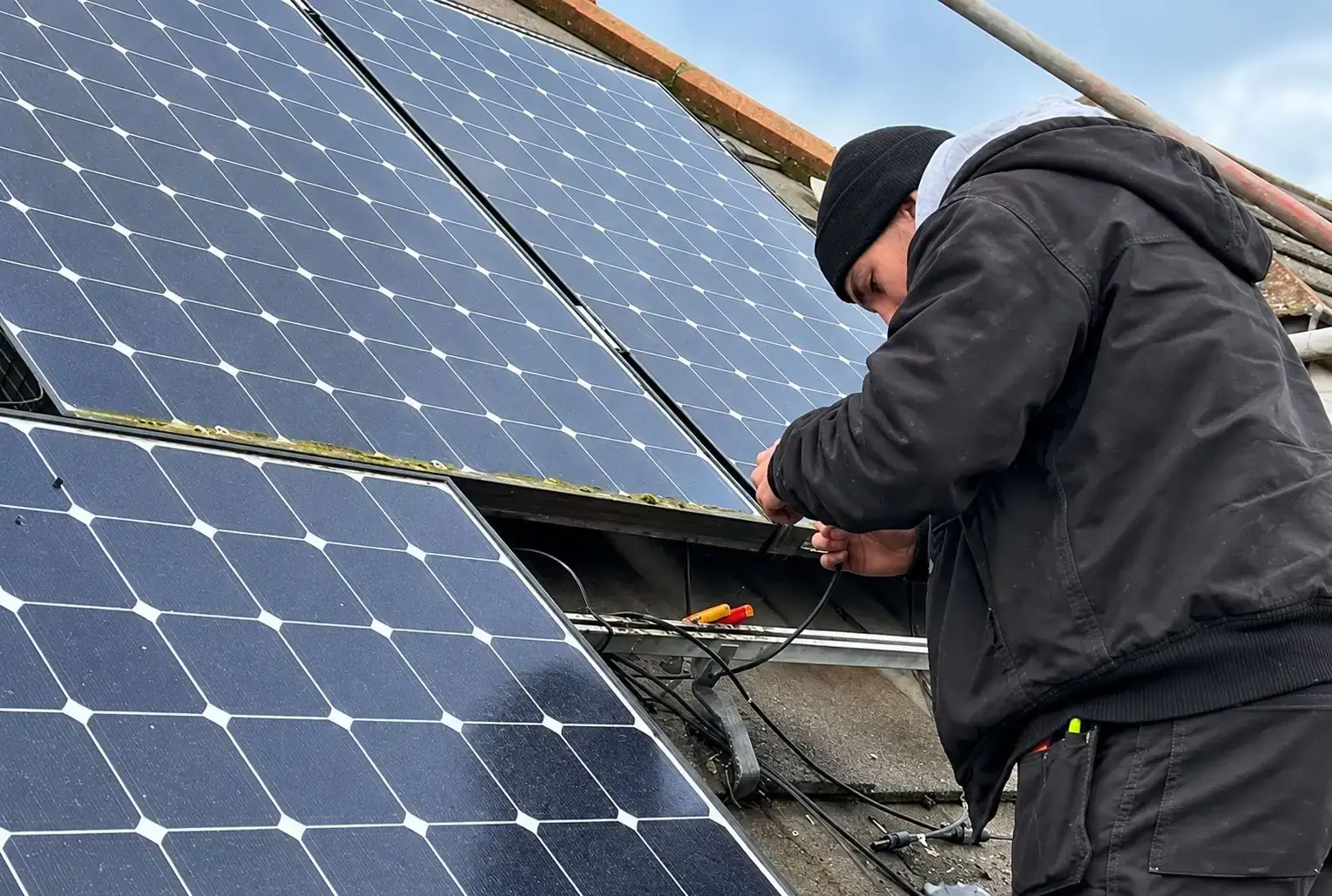
Solar thermal installation UK work must be carried out by a qualified engineer. A professional installation involves:
- A structural survey of the roof to confirm it can support the collector weight and fixing loads.
- Collector panel installation, including weatherproof flashings and bracket fixing.
- Primary circuit pipework run from the roof collectors to the plant room or airing cupboard.
- Pump station and expansion vessel installation.
- Solar cylinder installation or, where a suitable cylinder already exists, connection to it.
- Controller commissioning, including sensor calibration and pump test.
- System pressure testing and glycol fill.
- Building Regulations Part L compliance sign-off where applicable.
Homeowners who have inherited a system that was installed without proper paperwork, or where records are unavailable, should ask a qualified solar thermal engineer to carry out a system health check to confirm it is safe and performing correctly.
Common Mistakes Homeowners Make with Solar Thermal Systems
Most solar thermal problems are avoidable. These are the errors engineers encounter most often when called to systems that are not performing as they should.
Ignoring the Controller Display
The differential thermostat controller has a display that shows current temperatures and, on most modern units, cumulative energy yield. Many homeowners never look at it. Checking the display periodically is the simplest way to confirm the system is operating: if the pump is not running on a clear sunny day and the cylinder temperature is below 60 degrees, something is wrong. Checking the controller takes thirty seconds and can prevent a minor fault from becoming an expensive repair.
Letting System Pressure Drop Without Investigation
Solar thermal primary circuits are sealed and pressurised. If you notice the pressure gauge on the pump station has dropped from its normal operating range (typically 1.5 to 3 bar when cold), the system has lost fluid somewhere. Topping up without identifying the cause only masks the underlying problem. Persistent pressure loss usually indicates a failed expansion vessel, a faulty pressure relief valve, or a developing leak. An engineer should investigate before you just refill the system.
Not Testing the Glycol Fluid
This is the most costly mistake over the long term. Glycol degradation happens silently. There are no alarms, no warning lights, and no obvious change in hot water quality. By the time symptoms appear (typically in the form of corrosion damage to the pump impeller, the heat exchanger coil, or internal cylinder surfaces), the repair bill is substantially higher than a glycol test and replacement would have been. Testing glycol annually or biannually is genuinely preventative maintenance, not just good practice.
Assuming the System Is Working Because Hot Water Is Warm
Your boiler backup will top up the cylinder to 60 degrees regardless of what the solar thermal system is doing. A completely failed solar thermal system (disconnected pump, stalled controller, empty primary circuit) will not produce cold water: your boiler will simply run more often and cost more to operate. The only reliable way to confirm solar thermal is contributing is to check the controller yield display or have an engineer carry out a performance assessment.
Delaying Repairs After Visible Damage
A cracked collector glazing, a loose roof fixing, or corroded pipework fittings are often noticed but not acted on quickly. Water ingress into a flat plate collector destroys the absorber coating and insulation rapidly. A loose fixing risks collector movement in high winds. Minor damage that is repaired promptly costs a fraction of what a full collector replacement costs.
Expert Insights: What Engineers See on Service Visits
Solar Maintenance And Repairs engineers carry out solar thermal service visits across South England, from Hampshire and Dorset through to Surrey, Kent, and beyond. The following observations come directly from patterns seen across hundreds of service visits.
The Majority of Problems Are Fluid-Related
When a solar thermal system is performing below expectation, the primary circuit fluid is the first thing to check. In systems over eight years old that have never been tested, degraded glycol is present in a significant proportion of cases. The visual signs are telling: fluid that should be pale yellow or clear has turned dark brown or orange, with a sharp, acidic smell. In the most neglected cases, scale and sludge deposits are visible in the pump station filter. Replacing the fluid at this stage is effective, but it comes alongside a thorough flush of the primary circuit and, occasionally, pump replacement.
Controllers Are Often Miscalibrated or Faulty
A controller that has developed a sensor fault will either run the pump continuously (wasting electricity and heating the glycol unnecessarily) or fail to run it at all (meaning no heat transfer occurs even on sunny days). Both faults are straightforward to diagnose on-site with a basic temperature test. Replacement controllers are widely available and fitting one is typically a straightforward job. The problem is that homeowners rarely notice these faults because, as noted above, the boiler continues to heat the water regardless.
Expansion Vessels Lose Pre-Charge Over Time
Expansion vessels are pre-charged with nitrogen at the factory, typically to 1.5 bar. Over time, that nitrogen pressure reduces. When the pre-charge falls below the cold system pressure, the vessel can no longer absorb thermal expansion, and the pressure relief valve discharges instead. This is a common finding on systems over seven to ten years old. Re-pressurising or replacing the expansion vessel is a straightforward repair, but it is often the last thing homeowners think to check when the pressure relief valve begins to discharge.
Professional Recommendations for New Owners
If you have recently moved into a property with solar thermal installed, or if you realise your existing system has never been properly serviced, the following steps will establish a reliable baseline.
Commission a System Health Check
Before assuming your system is working correctly, arrange for a qualified solar thermal engineer to carry out a full system health check. This should cover glycol testing, pressure verification, pump operation, controller function, collector condition, and cylinder coil integrity. The findings give you an accurate picture of current system condition and a clear list of any work required.
Ask for Documentation
A properly installed solar thermal system should have an installation certificate, a commissioning record, and ideally a system diagram. If these are not with the property, request them from the previous owner or ask your engineer to document the system configuration during the health check visit. Knowing your system type, collector area, and cylinder volume will help you plan maintenance and make informed decisions about any future upgrades.
Set Up a Regular Maintenance Schedule
Annual or biannual glycol testing, combined with a full system service every three to five years, is the minimum required to keep a solar thermal system operating efficiently and safely. Arranging this proactively, rather than waiting for a problem to appear, consistently produces better long-term outcomes and lower overall costs.
Know Your Controller
Spend five minutes familiarising yourself with the controller display in your airing cupboard. Note the normal operating temperatures (typically 60 to 80 degrees at the collector on a sunny afternoon, and a rising cylinder temperature from late morning) and the cumulative yield figure if your controller shows one. These reference points make it far easier to identify when something is not behaving as it should.
How Solar Thermal Fits the Wider Renewable Energy Picture
A solar thermal system does not exist in isolation within your home’s energy setup. Understanding how it connects with your other systems helps you make the most of it and plan for future improvements.
If your property also has solar PV installed, the two systems work in parallel: solar PV generates electricity for general use, while solar thermal handles hot water separately and more efficiently than any electrical heating method. Adding a hot water diverter to your solar PV system allows surplus electricity to heat water as well, but solar thermal remains the more efficient dedicated hot water solution.
Battery storage pairs naturally with solar PV but has no direct relationship with solar thermal. Heat batteries and thermal stores are an emerging category that can store solar thermal output overnight, though these are less common in standard residential installations.
For homeowners considering a future heat pump installation, solar thermal and heat pump systems can be configured to work together: the solar thermal pre-heats the cylinder during the day, reducing the heat pump’s workload. Your engineer can advise on compatibility with specific heat pump models.
Conclusion
A solar thermal system UK homeowners inherit or install is one of the most straightforward and effective renewable technologies available for domestic hot water. Once you understand how the system works, what each component does, and what it needs to stay efficient, it becomes a genuinely low-maintenance asset rather than an unknown quantity in the airing cupboard.
The key points to take away: solar thermal captures heat from sunlight, not electricity; the glycol fluid in the primary circuit needs regular testing and periodic replacement; the differential thermostat controller tells you everything you need to know about daily performance; and your boiler running more than usual is often the only visible sign that something has gone wrong.
If you are based in Hampshire, Dorset, Surrey, West Sussex, or anywhere across South England, Solar Maintenance And Repairs engineers specialise in solar thermal maintenance and repairs across all major system types and brands. Whether you need a glycol test, a full service, or a system health check on a newly purchased property, we can help you keep your system running at its best.