
A solar thermal annual service UK homeowners often overlook is one of the most cost-effective things you can do for your system. Most solar thermal installations run quietly for years without obvious faults, which creates a false sense that everything is fine. The reality is that several of the most damaging problems, including glycol degradation and expansion vessel failure, produce no visible symptoms until the damage is already done. This article walks through every check a qualified Solar Maintenance And Repairs engineer carries out during a solar thermal service visit, explains the reason behind each task, and gives you the information you need to make an informed decision about your own system.
What Does a Solar Thermal Service Involve?
A professional solar thermal service is a systematic inspection and testing programme covering every functional component in the system. It is not simply a visual check and a top-up of pressure. A thorough service involves laboratory-grade fluid testing, component-level performance measurements, safety function verification, and a documented record of findings and any recommended follow-up work.
The service covers the complete primary circuit from the roof-mounted collectors down through the pipework, pump station, controller, and hot water cylinder. On most domestic installations, a full service visit covers ten distinct checks. Each one is designed to catch either a safety risk, an efficiency problem, or an early sign of developing failure before it becomes an expensive repair.
How Long Does a Solar Thermal Service Take?
A comprehensive solar thermal service on a standard domestic installation typically takes between one and two hours. Systems with more complex configurations, a larger collector array, or significant findings that require additional investigation or remedial work on the day may take longer. Engineers generally work through the indoor checks first (pump station, controller, cylinder, pipework) before proceeding to the roof inspection. You do not need to be present throughout but should be available to discuss findings at the end of the visit.
The Complete Solar Thermal Maintenance Checklist UK
The following ten checks form the core of a professional solar thermal service. Each is listed with the specific measurement or test involved and the reason it matters.
Check 1: Solar Thermal Fluid Test (Glycol pH and Concentration)
This is the single most important check in the entire service. The primary circuit of every solar thermal system contains a propylene glycol antifreeze mixture. That fluid degrades over time through a process of thermal cycling and oxidation. As it breaks down, the pH drops: the fluid becomes acidic.
The engineer withdraws a small sample of the primary circuit fluid and tests it in two ways:
- Refractometer reading: measures the glycol concentration to confirm the fluid still provides adequate frost protection (typically a reading equivalent to protection down to minus 15 degrees Celsius or lower for UK conditions).
- pH test: a reading below 6.5 indicates the fluid has become acidic. Acidic glycol attacks copper pipework, pump impellers, and the heat exchanger coil inside the cylinder. Left unchecked, it causes corrosion damage that can cost several hundred pounds to repair.
If the concentration is low or the pH is outside the acceptable range, the primary circuit must be flushed and refilled with fresh fluid. A correctly specified glycol mixture should maintain a pH between 7.5 and 9.0 throughout its service life. Engineers also look at the fluid colour: healthy glycol is pale yellow or clear; dark brown or orange fluid is a reliable visual indicator of degradation even before testing.
Industry standard: Test glycol every one to two years. Replace the fluid every five to seven years under normal operating conditions, or immediately if a test shows pH below 6.5 or concentration below the frost-protection threshold.
Check 2: Solar Thermal Pressure Check
The solar thermal primary circuit is a sealed, pressurised loop. It should hold a stable pressure of between 1.5 and 2.0 bar when cold. The engineer checks the pressure gauge on the pump station and compares it to the correct cold fill pressure for that specific installation (usually recorded on the commissioning certificate or marked on the pump station itself).
A pressure that is too low indicates fluid has been lost from the circuit. This happens through a failing pressure relief valve, a developing leak at a joint or fitting, or a failed expansion vessel that is allowing the relief valve to open repeatedly. Simply topping up the pressure without diagnosing the cause is not a service: it is a temporary mask over an ongoing problem.
A pressure that is too high is less common but equally significant. Overpressure usually points to a blocked or seized pressure relief valve that is no longer releasing at its set point, or an expansion vessel that has lost its nitrogen pre-charge entirely.
How to check solar thermal pressure yourself between services. You can monitor system pressure yourself between annual service visits. The pressure gauge is on the pump station unit, typically in your airing cupboard or plant room. Check it monthly during the winter months when thermal cycling is greatest. The cold pressure should sit between 1.5 and 2.0 bar (your commissioning documentation will specify the correct figure for your system). If pressure has dropped more than 0.3 bar since the last check, contact a qualified engineer rather than topping up yourself: identifying the source of the loss matters more than restoring the number on the gauge.
Homeowner tip: Photograph the pressure gauge display on your pump station at the same time each month and save the images with the date. This simple record gives an engineer immediate evidence of how quickly pressure is dropping, which helps diagnose the cause faster.
Check 3: Expansion Vessel Pre-Charge Pressure Test
The expansion vessel is a sealed container, pre-charged with nitrogen at the factory, that accommodates the increase in fluid volume as the glycol heats up and expands. Without it, thermal expansion would push primary circuit pressure to dangerous levels with every sunny day.
Over time, the nitrogen pre-charge pressure decreases. When it drops below the cold fill pressure of the system, the vessel can no longer absorb expansion effectively. The result is that the pressure relief valve opens instead, discharging a small amount of fluid to relieve the pressure. The pressure then drops below the correct level, and the cycle repeats.
The engineer isolates the expansion vessel and checks the pre-charge pressure with a tyre-type valve gauge. Correct pre-charge on a typical domestic solar thermal system is 1.0 to 1.5 bar. If the pre-charge has dropped, the vessel is re-pressurised with a foot pump. If the diaphragm inside the vessel has failed (indicated by fluid weeping from the Schrader valve when it is depressed), the vessel requires replacement. Expansion vessel replacement is a straightforward repair job and a common finding on systems over seven years old.
Check 4: Pump Station Flow Rate and Current Draw
The circulating pump is the mechanical heart of the primary circuit. It runs for potentially thousands of hours per year and is exposed to the heat and chemistry of the glycol fluid throughout its life. Two measurements confirm pump health:
- Flow rate: measured in litres per minute using the flow meter on the pump station. Each system has a design flow rate specified at installation (typically 1 to 2 litres per minute for domestic systems). A significantly reduced flow rate indicates pump wear, a blocked filter, or air entrainment in the primary circuit.
- Current draw: measured with a clamp meter around the pump’s live supply cable. A pump drawing more current than its rated wattage is working harder than it should, which indicates increased internal resistance from bearing wear or a partially blocked rotor. A pump drawing too little current may have a winding fault.
Pump faults that are caught at the flow-rate and current-draw stage are typically resolved with a pump replacement. Pumps that are allowed to fail completely can cause the glycol to overheat and degrade rapidly, sometimes in a single overcast season, because the fluid is no longer circulating to transfer heat away from the collectors.
Check 5: Differential Thermostat Controller Calibration
The differential thermostat controller (DTC) governs when the pump runs and when it stops. Its decisions are based on the temperature difference between two sensors: one at the collector and one at the base of the cylinder. If either sensor has drifted from its calibrated value, the controller will make incorrect decisions.
The engineer tests both sensors by comparing their displayed readings against a calibrated reference thermometer at known temperatures. A sensor reading two or three degrees high or low may seem minor, but it can mean the pump activates too early (wasting electricity), too late (losing available solar heat), or not at all on marginally useful days.
The engineer also reviews the controller’s set points:
- Switch-on differential: the temperature difference required to start the pump (typically 5 to 8 degrees Celsius above cylinder base temperature).
- Switch-off differential: the temperature difference at which the pump stops (typically 2 to 3 degrees above cylinder base temperature).
- Maximum cylinder temperature: the upper limit at which the controller suspends pump operation to prevent overheating (typically 70 to 80 degrees Celsius).
- Frost protection activation temperature: the collector temperature at which the controller briefly runs the pump to prevent freezing (typically 3 to 4 degrees Celsius).
Incorrectly set parameters are surprisingly common on older systems, particularly where controllers have been reset after a power cut and default values have not been corrected.
Check 6: Solar Thermal Collector Inspection
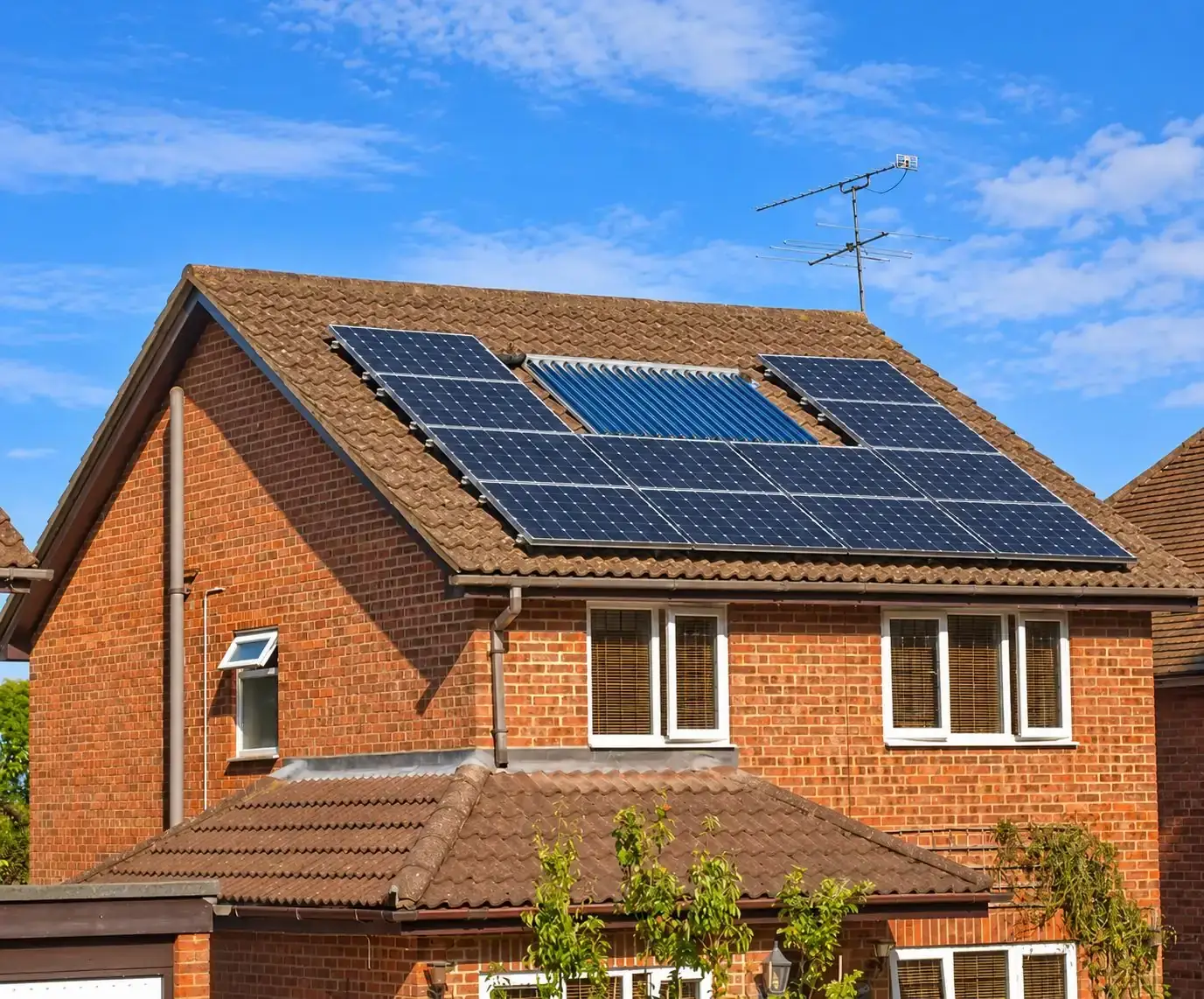
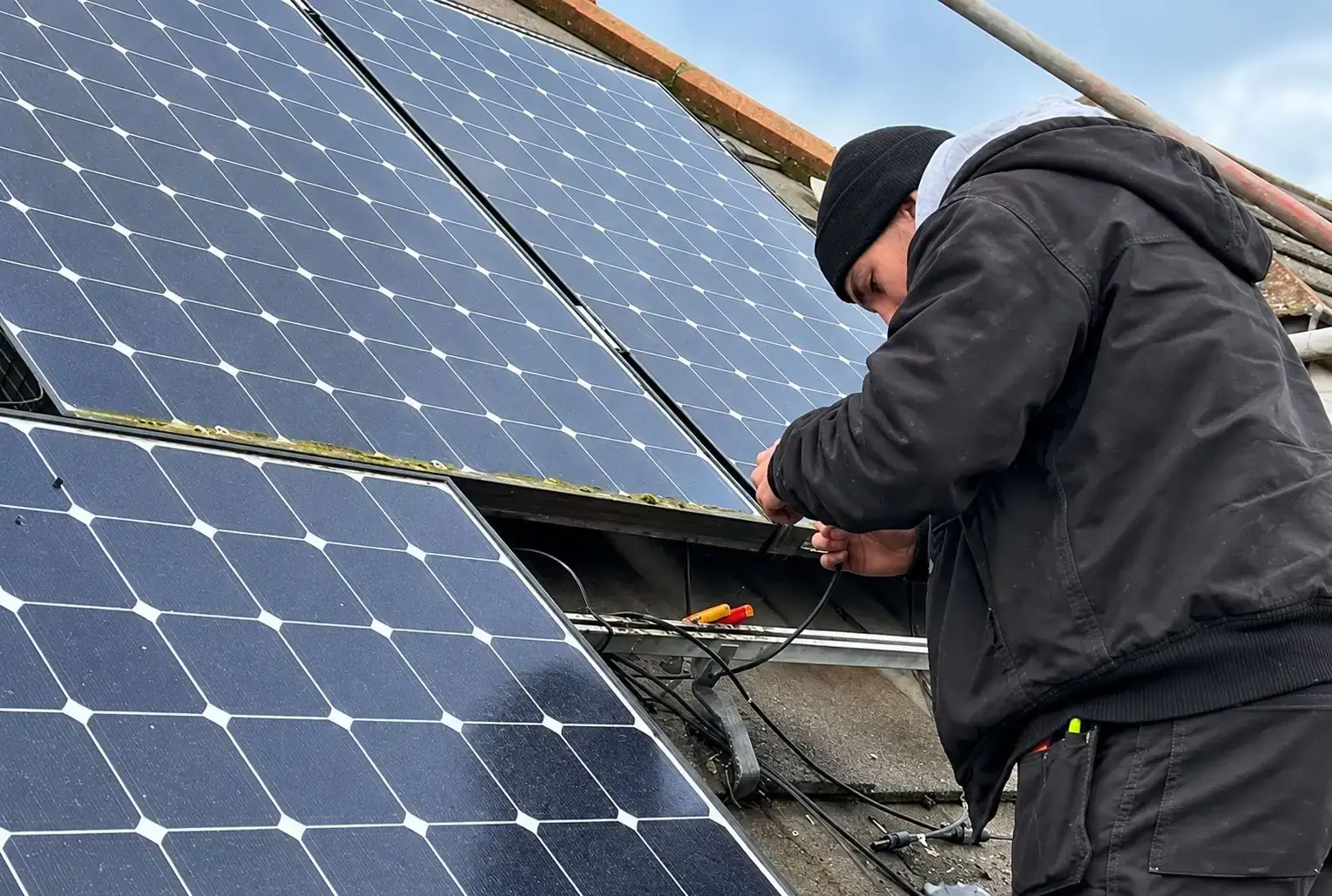
The roof inspection is the most visible part of the service and the one that most directly addresses physical system safety. The engineer examines the collectors and their roof fixings, looking for:
- Cracked or broken glazing on flat plate collectors, which allows moisture ingress that destroys the absorber coating and insulation permanently.
- Damaged or degraded seals around the collector frame and glazing, which allow condensation to form inside the panel and reduce thermal performance.
- Corroded or loose roof fixings. Collectors are heavy and act as wind sails in storm conditions. A loose fixing that is not addressed can result in a collector becoming dislodged.
- Broken or cracked evacuated tubes on tube-type collectors. Individual tubes on most designs can be replaced without removing the entire array, but cracked tubes reduce efficiency proportionally.
- Evidence of shading that was not present at installation, from tree growth, new dormer windows, satellite dishes, or adjacent structures.
- Soiling or debris accumulation. Significant soiling (bird droppings, moss, lichen) reduces the radiation absorbed by the collector surface and should be cleaned by a qualified engineer with safe roof access.
Safety note: Homeowners should never attempt to inspect or clean roof-mounted solar collectors without professional roof access equipment. Falls from roofs are the most serious risk associated with domestic renewable energy systems. This check is always carried out by a trained engineer with appropriate working-at-height equipment.
Check 7: Heat Exchanger and Cylinder Coil Performance
The lower solar coil inside the hot water cylinder is the interface between the primary circuit glycol and the domestic hot water. Over time, scale can build up on the coil surface (particularly in hard water areas such as much of Hampshire and Surrey), reducing heat transfer efficiency. In extreme cases, particularly where glycol has been allowed to degrade and become acidic, the coil itself can develop pinhole corrosion.
The engineer assesses heat exchanger performance by comparing inlet and outlet temperatures across the coil at a known flow rate, then calculating the heat transfer rate. A coil performing below specification points to scaling or corrosion. Full coil inspection requires cylinder drain-down and is carried out when performance data indicates a problem, rather than as a routine service task on every visit.
The engineer also checks the cylinder thermostat, immersion heater operation (where fitted), and the condition of the cylinder insulation jacket.
Check 8: Pressure Relief Valve Function Test
The pressure relief valve is a safety device. If primary circuit pressure exceeds the valve’s set point (typically 6 bar on domestic installations), it opens and releases fluid to protect the system from over-pressure damage. Like all safety valves, it must be tested periodically to confirm it opens at the correct pressure and reseats properly afterwards.
The engineer manually operates the valve using the test lever to confirm it opens freely, releases fluid as designed, and reseats without continuing to weep after the lever is released. A valve that will not open, opens at the wrong pressure, or continues to weep after testing requires immediate replacement. A seized or non-functioning pressure relief valve is a genuine safety risk on any pressurised heating system.
Check 9: Solar Thermal Inhibitor Level Check
In addition to the antifreeze glycol, the primary circuit fluid should contain a corrosion inhibitor package. The inhibitor protects the metals in the primary circuit (copper pipework, brass fittings, aluminium pump components, stainless steel heat exchanger coil) from electrochemical corrosion. Inhibitor depletes over time, particularly at elevated operating temperatures, and must be replenished.
The engineer tests inhibitor concentration using test strips or a colorimetric kit. Where concentration is below the minimum recommended level, inhibitor is topped up by introducing a measured dose directly into the primary circuit via the pump station fill valve. Correct inhibitor concentration is as important as correct glycol concentration: a primary circuit with good antifreeze protection but depleted inhibitor will still corrode.
Check 10: Pipe Insulation and Lagging Condition
The solar thermal primary circuit pipework runs from the roof collectors down through the property to the cylinder. Any section of pipework exposed to cold conditions (roof voids, loft spaces, external walls, unheated plant rooms) must be properly insulated to prevent heat loss from the glycol as it travels between the collector and the cylinder, and to prevent freezing risk in severe cold.
The engineer inspects all accessible pipe lagging for condition. UV degradation causes external lagging to become brittle and crumble on pipework runs that pass through roof voids with roof light exposure. Rodent damage to pipe insulation in loft spaces is also a common finding. Where lagging is damaged or absent, the engineer will recommend replacement before the next winter.
How Often Should a Solar Thermal System Be Serviced in the UK?
The standard recommendation in the UK solar thermal industry is a full service every one to two years, with glycol testing at least annually. This interval reflects the rate of glycol degradation under typical UK operating conditions, the thermal cycling the primary circuit undergoes across seasons, and the wear rate of mechanical components such as the pump and expansion vessel.
Systems that are older, operating in particularly hard water areas, or which have a history of missed services should be moved to annual servicing until a clean bill of health has been established and maintained across two consecutive visits.
Some homeowners choose to have glycol tested annually by their engineer and schedule a full service every other year. This is a reasonable approach provided the glycol results remain consistently within specification. The moment a test result indicates the fluid is approaching the limits of acceptability, a full service with fluid replacement should be brought forward.
One practical rule: if you cannot find any evidence of a service having taken place in the last three years, treat the system as overdue and book a comprehensive health check rather than a standard annual service. The findings will determine the correct maintenance frequency going forward.
What Does Solar Thermal Servicing Cost in the UK?
Solar thermal maintenance cost UK figures vary depending on the provider, the complexity of the installation, and the geographic location of the property. As a general guide for domestic systems in South England:
- A standard annual service visit, covering all ten checks listed above, typically ranges from 120 to 200 pounds.
- A service that includes glycol replacement (primary circuit drain, flush, and refill with fresh fluid) will cost more, typically in the range of 250 to 400 pounds depending on the volume of the primary circuit and fluid costs.
- Expansion vessel replacement, where required, typically adds 80 to 150 pounds including parts and labour.
- Controller replacement, if necessary, typically ranges from 150 to 300 pounds depending on the model required.
These figures reflect the cost of a thorough, documented service by a qualified solar thermal engineer. Cheaper quotes from non-specialist providers frequently result in incomplete checks, undocumented findings, and, in some cases, incorrect glycol top-up that dilutes rather than restores the primary circuit fluid.
The most relevant cost comparison is not service cost versus no service cost, but service cost versus repair cost. A glycol replacement at 300 pounds prevents pump and heat exchanger corrosion that can cost 600 to 1,500 pounds to address once damage has occurred. A 150-pound expansion vessel replacement prevents repeated pressure relief valve discharge that can eventually cause the valve to stick open permanently, requiring cylinder drain-down and valve replacement.
Can You Service Your Own Solar Thermal System?
This question comes up often, and the honest answer is: partly, but not fully, and the parts you cannot do yourself are the most important ones.
A homeowner can reasonably carry out the following between professional service visits:
- Check the pressure gauge on the pump station monthly and note any change.
- Check the controller display to confirm the pump is running on sunny days and the cylinder temperature is rising as expected.
- Note any unusual noises from the pump station (grinding, vibration, or intermittent operation).
- Visually inspect accessible pipework and lagging from ground level or from inside the loft if safely accessible.
What a homeowner should not attempt without professional training and equipment:
- Glycol pH and concentration testing: requires a calibrated refractometer and an understanding of how to interpret results correctly. A misread result can give false reassurance about fluid condition.
- Pressure relief valve testing: manually operating a valve that has been seated for several years carries a risk of the valve not reseating correctly. This should only be done by an engineer who has a replacement valve available.
- Roof-level collector inspection: working at height on a domestic roof requires appropriate fall protection equipment. This is not a task for a ladder and a willing homeowner.
- Expansion vessel pre-charge checking: isolating the vessel and testing the Schrader valve requires the system to be in the correct pressure state and the vessel to be correctly isolated from the primary circuit first.
A DIY partial check combined with an annual professional service is a sensible approach. Attempting to replace professional servicing entirely with homeowner checks is not.
What Happens If You Do Not Service Your Solar Thermal System?
The consequences of neglecting solar thermal maintenance follow a predictable sequence, and the cost and disruption increase at each stage.
Stage 1: Silent Efficiency Loss (Years 1 to 3 without service)
Glycol begins to degrade. Inhibitor levels drop. The system continues to heat water, but the boiler runs slightly more often than it should because solar contribution is reducing. The homeowner notices nothing, but energy bills are marginally higher than a well-maintained equivalent system.
Stage 2: Mechanical Wear (Years 3 to 6 without service)
Degraded glycol becomes acidic. The pump impeller begins to show corrosion. The expansion vessel pre-charge has dropped, so the pressure relief valve discharges occasionally on hot days. The homeowner may notice a damp patch under the relief valve outlet or a gradual pressure drop that requires occasional top-up.
Stage 3: Component Failure (Year 6 and Beyond without service)
The pump fails due to impeller corrosion. The pressure relief valve sticks open due to repeated discharge. The lower cylinder coil develops pinhole corrosion from the acidic glycol. At this stage, the system has either stopped contributing to hot water heating entirely, or is actively leaking primary circuit fluid. Remediation typically involves pump replacement, valve replacement, glycol replacement and circuit flush, and, in serious cases, cylinder replacement. Total repair costs at this stage can reach 1,000 to 2,500 pounds.
The painful reality is that every pound of this repair cost was preventable with routine servicing that would have cost a fraction of the remediation bill.
Expert Insights: What the Checks Reveal in Practice
Solar Maintenance And Repairs engineers carry out solar thermal service visits across South England throughout the year. The following observations reflect patterns seen repeatedly across a wide range of domestic solar thermal systems.
Glycol Condition Is the Most Consistent Finding
On systems that have been serviced regularly, glycol results are almost always within specification. On systems presented for a first service after five or more years without documented maintenance, degraded glycol is found in the majority of cases. The visual presentation varies: some systems show dark orange fluid with obvious sludge in the pump station filter; others show fluid that looks acceptable to the naked eye but tests at pH 6.0 or below. The refractometer reading does not reliably indicate pH, which is why both tests are always performed. A system whose owner says ‘we had the pressure topped up a couple of years ago’ is not the same as a system that has been serviced: pressure top-up is not glycol testing.
Controller Faults Are Often Present But Invisible
It is not unusual to arrive at a system where the controller is displaying normal-looking temperatures but the pump has not been running. This is typically caused by a failed relay inside the controller, a sensor that has drifted by enough to prevent the switch-on differential being reached, or a pump that has seized and is drawing current without rotating. In every case, the homeowner’s boiler has been quietly compensating, and the solar thermal system has been contributing nothing for an unknown period. Restoring the system to operation in these cases always produces a noticeable reduction in boiler usage.
Expansion Vessel Findings Cluster in the 7 to 12 Year Age Band
Expansion vessels have a typical service life of 10 to 15 years under normal operating conditions, but pre-charge loss accelerates when the primary circuit operates at consistently high temperatures (as happens when the collector overheat protection threshold is reached on summer days). The 7 to 12 year band is where pre-charge problems are found most reliably. In many cases, re-pressurising the vessel with a foot pump restores correct function for several more years. In cases where the diaphragm has perforated, replacement is the only option.
Industry Best Practices for Solar Thermal Maintenance
The following practices represent the current standard expected of a qualified solar thermal service engineer in the UK.
- All service checks should be documented and the homeowner provided with a written service record, including glycol test results, pressure readings, and any recommendations for follow-up work.
- Glycol test results should state both the pH value and the refractometer reading (expressed as a freeze-protection temperature equivalent), not just a pass or fail.
- Where glycol requires replacement, the primary circuit should be flushed before refilling, not simply drained and refilled. Flushing removes degraded fluid and any loose corrosion products from the circuit.
- The pressure relief valve function test should be completed at every service, not skipped on the basis that the system appears to be holding pressure correctly.
- Any roof-level inspection must be carried out with appropriate working-at-height equipment. An engineer who does not access the roof as part of a solar thermal service is providing an incomplete service.
- Service records should be retained by the homeowner and made available to subsequent engineers or presented on property sale. A documented service history is increasingly expected by conveyancing solicitors and home buyers.
Troubleshooting Advice: Signs Your System Needs Attention Now
The following signs indicate a solar thermal system that needs a professional assessment promptly, outside of the regular service cycle.
Pressure Dropping Repeatedly
If you need to top up system pressure more than once in a three-month period, the primary circuit has a leak or the expansion vessel has failed. Do not continue topping up: the lost fluid goes somewhere, and that somewhere is either a developing leak or a repeatedly discharging pressure relief valve. Both need professional diagnosis.
Hot Water Noticeably Less Effective in Summer
If your hot water performance in June and July is no better than in December, the solar contribution has stopped or reduced drastically. Check the controller display: if the pump is not activating on clear sunny days and the cylinder temperature is not rising from mid-morning, the controller, pump, or primary circuit fluid is the likely cause. Book a service.
Fluid Around the Pressure Relief Valve Outlet
A small amount of staining below the pressure relief valve outlet indicates the valve has been discharging. This is normal behaviour during extreme summer overheating, but repeated or constant discharge is not. It points to an expansion vessel that is no longer functioning correctly. Left unaddressed, repeated discharge eventually damages the valve seat and the valve then weeps continuously, requiring replacement.
Pump Station Making Unusual Noises
A healthy solar thermal pump runs quietly. Grinding, rattling, or intermittent noise from the pump station indicates bearing wear or debris in the pump body. A failing pump that is still running partially is preferable to one that has seized completely, but both require professional attention. Early replacement of a worn pump is significantly cheaper than dealing with the consequences of a seized pump that has allowed the glycol to overheat.
Controller Showing Error Codes or Blank Display
Error codes on the controller display indicate a sensor fault, communication error, or internal failure. A blank display that cannot be restored by cycling the power supply indicates the controller has failed. In both cases the system will not be controlling the pump correctly, and a replacement controller will be required. Most controllers are plug-compatible replacements and can be fitted within a standard service visit.
Solar Thermal Servicing Across Hampshire, Surrey and Kent
Solar Maintenance And Repairs provides professional solar thermal annual service visits across South England, covering Hampshire, Surrey, Kent, Dorset, West Sussex, East Sussex, Wiltshire, Somerset, Devon, Berkshire, and all other counties within our service area. Our engineers are experienced across all major solar thermal brands and system configurations, including Viessmann, Worcester Bosch, Navitron, Thermomax, Kingspan, and Solfex.
For homeowners in Hampshire, our engineers cover all major towns and villages across the county, from Southampton and Portsmouth to Winchester, Basingstoke, Andover, and rural areas throughout the New Forest and Test Valley. Solar thermal service Hampshire bookings are typically available within five to ten working days.
In Surrey, we cover the full county from the Surrey Hills down through Guildford, Woking, Reigate, and into the M25 corridor. Solar thermal service Surrey appointments are available across the county, including areas close to the Greater London boundary.
Our Kent coverage extends across the Garden of England, including Maidstone, Tonbridge, Tunbridge Wells, Canterbury, and coastal towns including Folkestone and Whitstable. Solar thermal service Kent bookings follow the same prompt response standard as all other areas.
To book a solar thermal annual service, call Solar Maintenance And Repairs on 0330 111 9399 or use the contact form to request an appointment. Our engineers are happy to discuss your system before the visit if you have specific concerns or questions about what the service will involve.
Conclusion
A solar thermal annual service UK homeowners schedule regularly is not an optional extra: it is the most reliable way to protect a significant home asset, maintain hot water efficiency, and avoid the far higher costs that come with deferred maintenance. The ten checks described in this article cover every aspect of system health, from the fluid chemistry that prevents corrosion to the safety components that protect the primary circuit from over-pressure.
The key message is straightforward. Solar thermal systems are durable and largely self-managing in day-to-day operation, but they are not maintenance-free. Glycol degrades, expansion vessels lose pre-charge, pump bearings wear, and controllers drift. A professional annual service catches all of these at the stage where they are inexpensive to address.