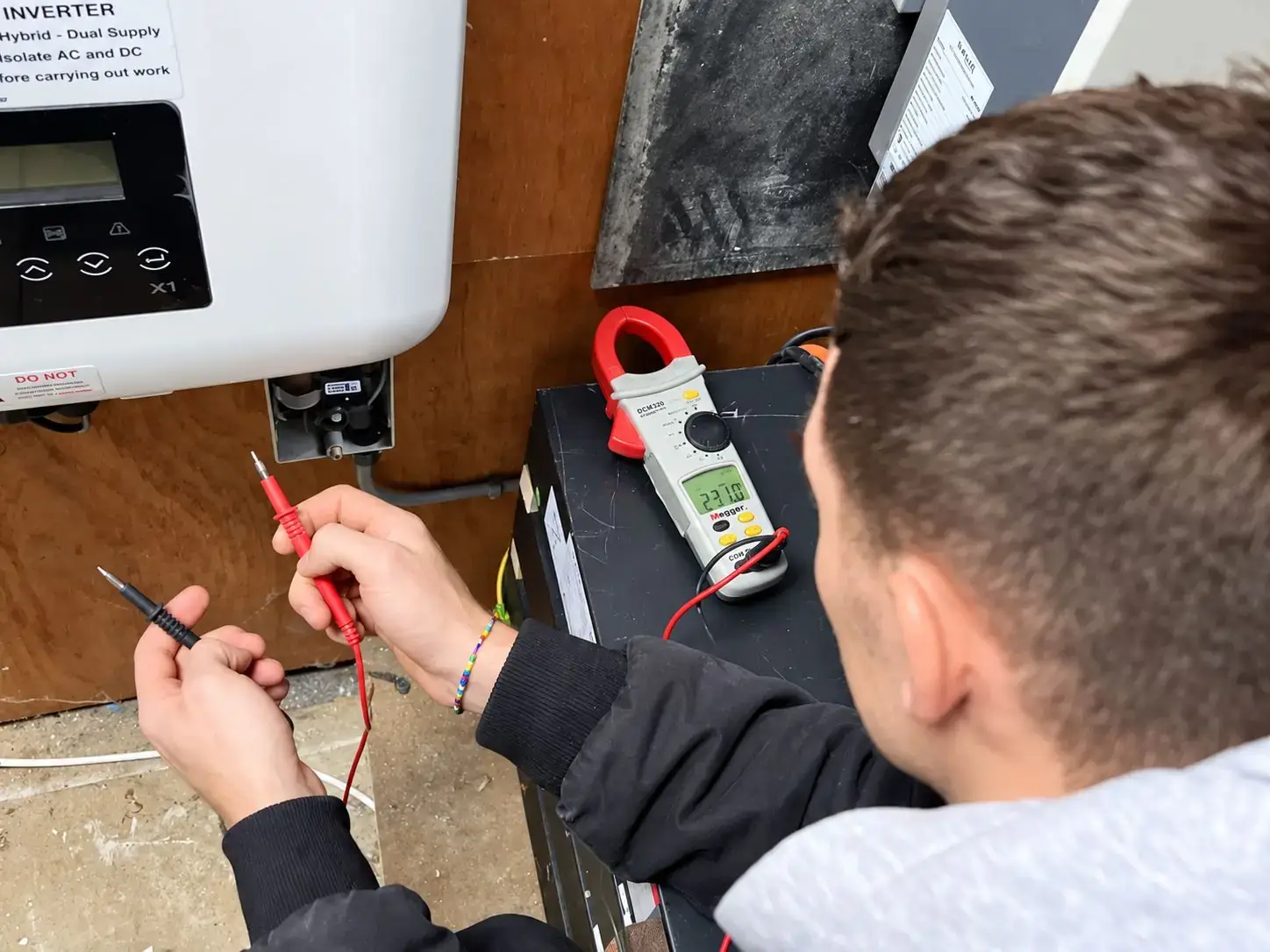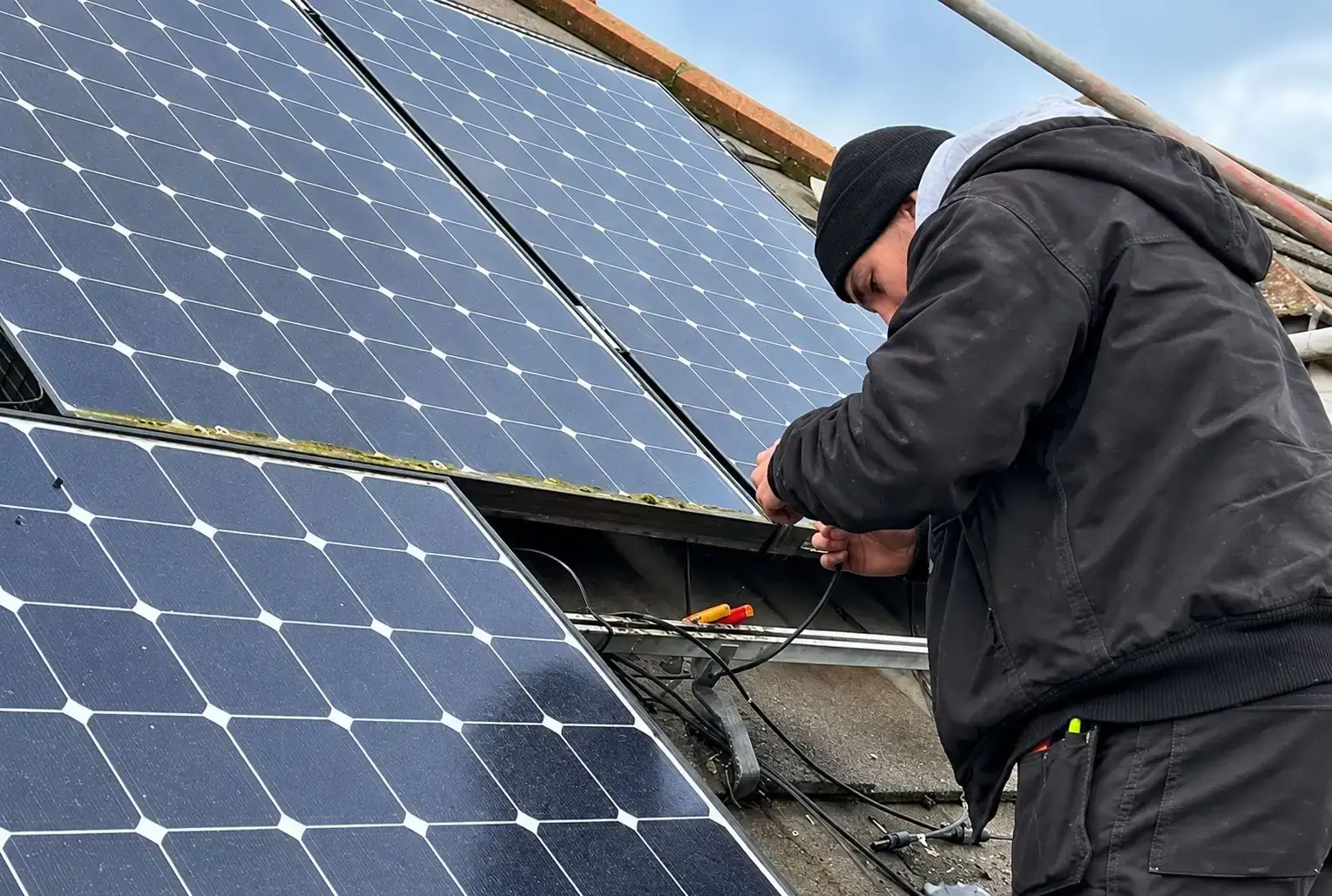
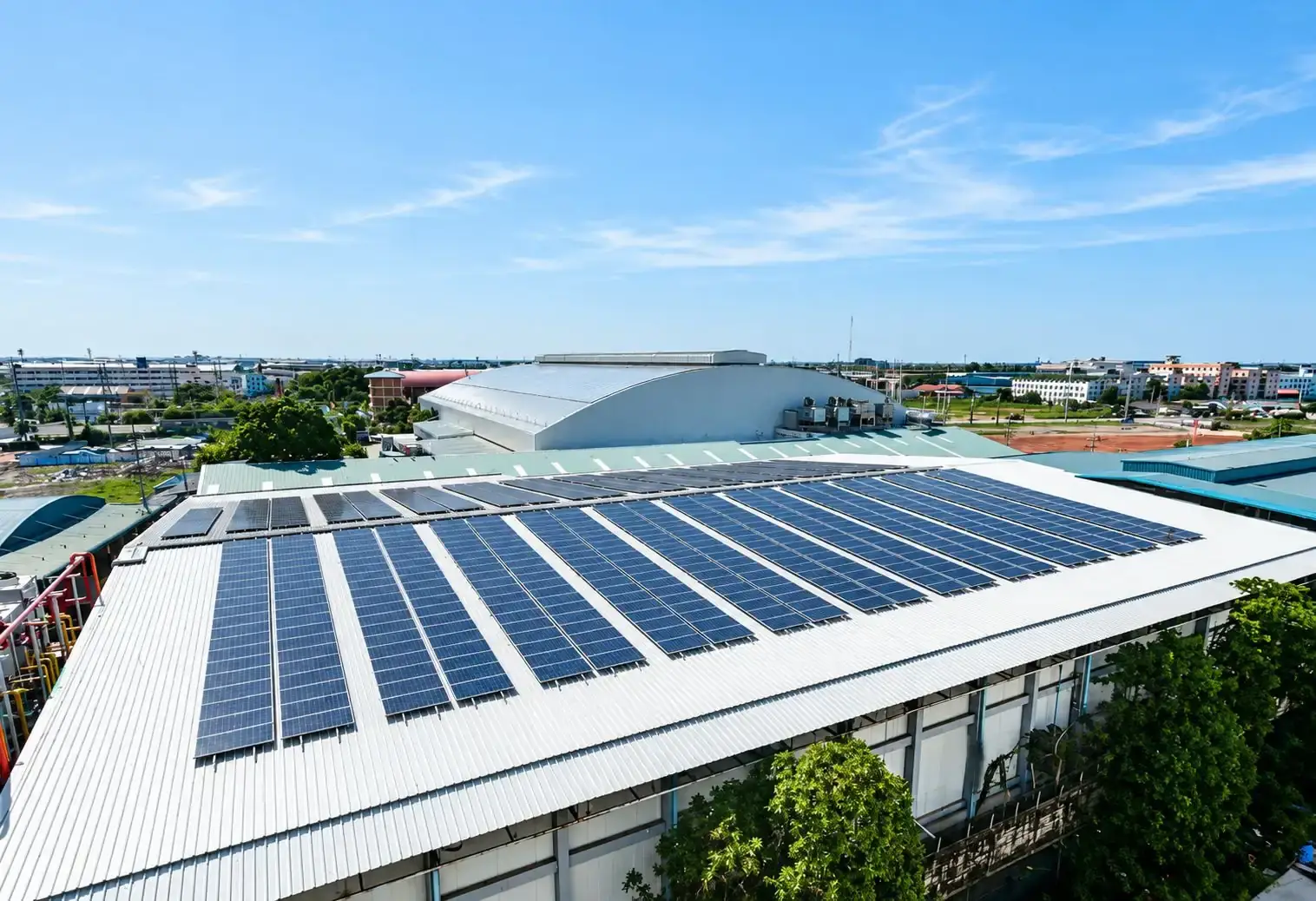

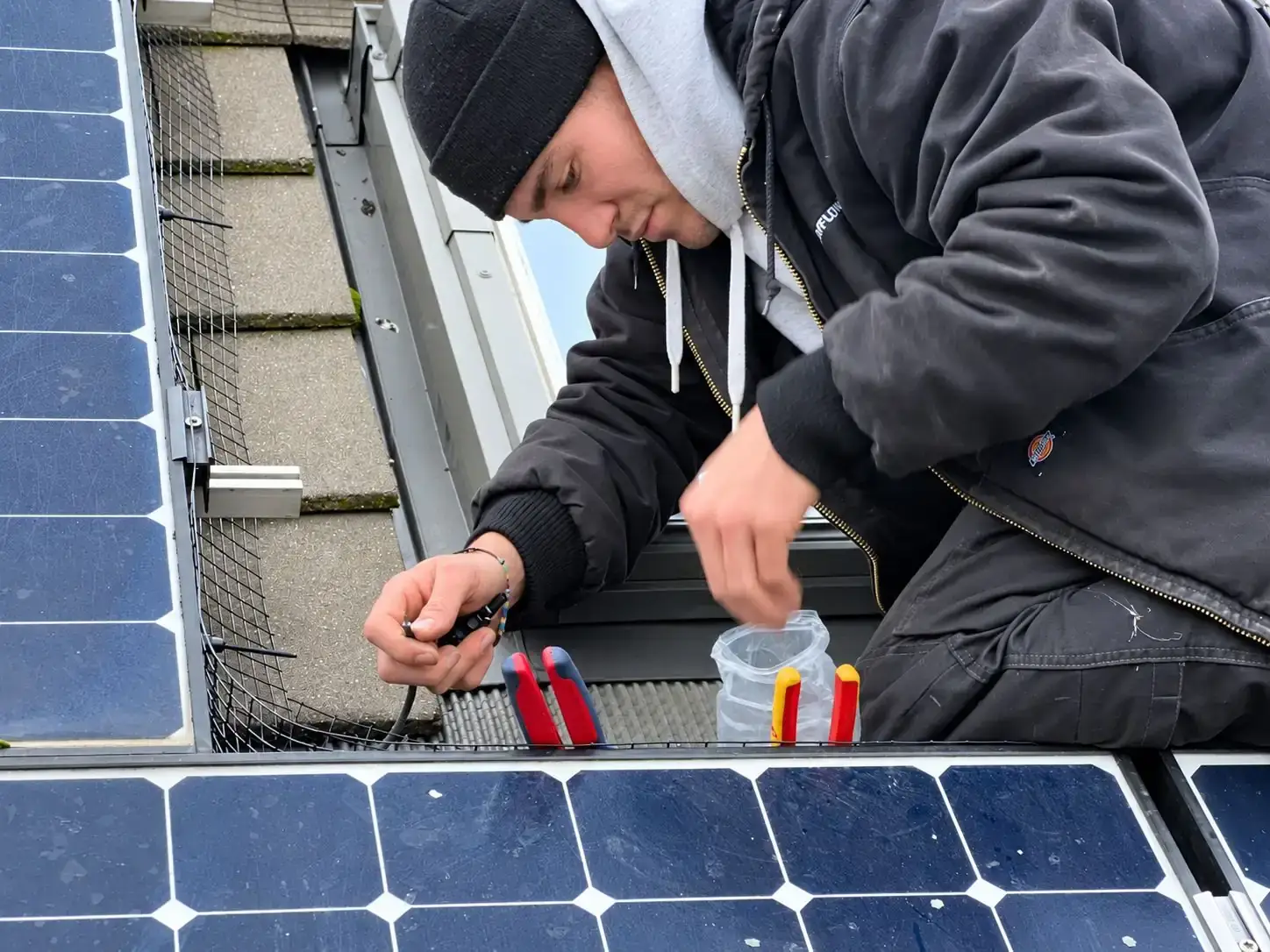
A solar inverter is the device that converts the direct current (DC) electricity produced by your solar panels into the alternating current (AC) electricity that powers your home appliances and feeds into the National Grid. Without a solar inverter, the electricity your panels generate cannot be used by anything in your property. It is, in simple terms, the essential translator between your solar array and everything connected to your home’s consumer unit.
If you have solar panels installed and want to understand what is a solar inverter and what it does every day, this guide covers the complete picture: how the conversion process works, the different types available, how long inverters last, what problems to watch for, and how to tell whether yours is doing its job correctly.
What Does a Solar Inverter Do?
Your solar panels produce DC electricity. DC flows in one direction at a constant voltage, which is the natural output of photovoltaic (PV) cells responding to sunlight. The problem is that virtually every appliance in a UK home, and the National Grid itself, runs on AC electricity. AC alternates direction at 50 cycles per second (50 Hz) and at a nominal voltage of 230 volts.
The solar inverter bridges that gap. It takes the variable DC output from your panels, which fluctuates depending on light levels throughout the day, and converts it into stable, grid-compatible 230V 50Hz AC power. That converted electricity then flows through your consumer unit to power your appliances directly, with any surplus exported to the grid via your meter.
Beyond simple conversion, a modern solar power inverter UK homeowners have installed also:
- Tracks the maximum power point of the solar array to extract the greatest possible energy output at any given moment.
- Monitors system performance and logs daily and cumulative energy generation data.
- Communicates with the grid to meet safety requirements, disconnecting automatically during a power cut to protect line workers.
- Manages battery charging and discharging on hybrid systems.
- Provides fault diagnostics, generating error codes that help engineers identify problems quickly.
How Does a Solar Inverter Work?
The core process inside a solar inverter involves power electronics operating at very high switching frequencies. The sequence from panel output to usable AC power has several stages, each of which matters to overall performance.
How Does a Solar Inverter Convert DC to AC?
The solar inverter DC to AC conversion process works as follows:
- DC input stage: The inverter receives the raw DC output from your solar panels. In a string inverter, this is the combined output of all panels connected in series. In a microinverter, it is the output of a single panel.
- MPPT stage: The inverter’s Maximum Power Point Tracking algorithm continuously adjusts the load it presents to the panels to ensure they are operating at their peak power output voltage, regardless of changes in light intensity or temperature.
- DC-DC conversion: The raw panel voltage (which may be 200 to 600V DC on a typical domestic string system) is conditioned and regulated.
- DC-AC inversion: A set of electronic switches called IGBTs (Insulated Gate Bipolar Transistors) switch the DC on and off at extremely high speed, creating a rapidly alternating signal.
- Filtering and smoothing: That high-frequency switching signal is filtered through inductors and capacitors to produce a smooth, pure sine wave AC output at the correct voltage and frequency.
- Grid synchronisation: The inverter synchronises its output precisely with the grid voltage and frequency before allowing electricity to flow, ensuring the two are in phase.
The entire sequence from DC input to AC output happens continuously, thousands of times per second, and is monitored electronically throughout. The quality of the resulting AC waveform matters: a pure sine wave output is essential for sensitive modern appliances including computers, variable-speed motor drives, and medical equipment. All grid-tied solar inverters produce pure sine wave output by design.
What Is MPPT in a Solar Inverter?
MPPT stands for Maximum Power Point Tracking. It is one of the most important functions inside a solar inverter, and understanding it explains why inverter quality matters so much to overall system performance.
A solar panel does not produce a fixed output. Its voltage and current relationship changes continuously as light levels, panel temperature, and partial shading conditions vary throughout the day. At any given moment, there is a specific voltage at which the panel produces its maximum power output. That voltage is called the Maximum Power Point.
A solar inverter MPPT algorithm continuously scans the panel’s voltage-current curve and adjusts the load it presents to the panels to keep them operating at exactly that point. Without MPPT, the panels would rarely operate at peak efficiency, and a significant proportion of available energy would be wasted.
High-quality inverters from manufacturers including SolarEdge, Fronius, SMA, and Enphase use sophisticated multi-channel MPPT algorithms that respond to rapid changes in irradiance, such as cloud shadows passing over part of the array, within milliseconds. Entry-level inverters use simpler single-channel MPPT that is slower to respond and less precise under variable conditions.
What Is a Pure Sine Wave Output?
AC electricity can be described by its waveform: the shape of the voltage signal over time. True grid electricity and high-quality solar inverter output both produce a pure sine wave: a smooth, continuously curving signal that rises and falls symmetrically 50 times per second.
Some cheap inverters, particularly older off-grid models, produce a modified sine wave instead: a stepped approximation of a true sine wave. Modified sine wave output causes problems with inductive loads (motors, transformers), produces audible hum in audio equipment, and can damage some electronic devices over time. Any inverter connected to the UK grid must produce a pure sine wave output compliant with Engineering Recommendation G98 or G99. This is a regulatory requirement, not a manufacturer preference.
Types of Solar Inverters: Which Type Do You Have?
There are five main types of solar inverters used in UK residential and commercial installations. Understanding the differences helps you interpret your system’s behaviour, understand its limitations, and make informed decisions about upgrades.
String Inverters
A string inverter solar installation is by far the most common configuration in UK domestic solar PV systems installed before 2020. In a string system, multiple solar panels are connected together in a series string, and that string connects to a single central inverter. Most homes have one or two strings connecting to one inverter, which is typically wall-mounted in a garage, utility room, or loft.
String inverters are proven, cost-effective, and straightforward to maintain and replace. Their main limitation is sensitivity to shading: because all panels in a string are electrically linked, the performance of the entire string is constrained by the worst-performing panel. A single shaded panel can reduce the output of the whole string significantly.
Common string inverter brands in the UK include SMA, Fronius, SolarEdge (with power optimisers), Growatt, Sungrow, and Ginlong Solis.
Microinverters
A microinverter is a small inverter fitted to each individual solar panel, rather than a single central unit for the whole array. Each panel converts its DC output to AC independently, which means the performance of one panel has no effect on the others. This makes microinverter systems significantly more resilient to partial shading and panel mismatch.
Microinverter systems also provide panel-level monitoring: you can see exactly how much each individual panel is generating at any time, which makes fault diagnosis far more precise than a string system where only the total array output is visible.
The leading microinverter brand in the UK is Enphase. Microinverter systems cost more to install than string systems but typically produce more energy from the same panel array on roofs with shading or mixed orientations. Because each unit is smaller and runs cooler, microinverters often carry longer warranties than string inverters.
Hybrid Solar Inverters
A hybrid solar inverter is a single unit that combines the functions of a solar inverter and a battery inverter-charger. It manages the solar panels, charges and discharges a connected battery storage system, and exports or imports electricity to and from the grid, all within one box.
Hybrid inverters are the standard specification for new solar PV plus battery storage installations. Popular hybrid inverter brands in the UK include GivEnergy, SolarEdge, Growatt, Sungrow, and Solax. If your home has a battery storage system installed alongside your solar panels, you almost certainly have a hybrid inverter.
The advantage of a hybrid system is that surplus solar generation that would otherwise be exported to the grid at a low export tariff rate is instead stored in the battery for use in the evening, significantly increasing the proportion of your own solar generation that you actually consume.
Grid-Tie Solar Inverters
A grid tie solar inverter is any inverter designed to connect to and work in parallel with the public electricity grid. This is the category that covers most UK domestic string and hybrid inverters. Grid-tie inverters synchronise their output with the grid and can export surplus electricity automatically. They are required by regulation to disconnect from the grid during a power cut, for safety reasons, which means a standard grid-tie inverter will not power your home during a grid outage even if your panels are generating.
Off-Grid Solar Inverters
An off grid solar inverter is designed for systems with no connection to the National Grid. They are used in remote properties, cabins, boats, and agricultural buildings where grid connection is impractical or too expensive. Off-grid systems always include battery storage, and the inverter manages charging from solar panels and discharging to loads independently of any external grid reference.
Off-grid inverters are uncommon in standard UK domestic solar PV installations but are relevant to a proportion of rural properties across the South England counties Solar Maintenance And Repairs, particularly in Devon, Somerset, and parts of Wiltshire and Dorset.
Is a Solar Inverter the Same as a Charge Controller or Battery?
These three components are frequently confused by homeowners, particularly those researching solar battery storage for the first time. They perform distinct functions:
- Solar inverter: converts DC electricity from panels to AC for home use or grid export. In a hybrid system, also manages battery charging and discharging.
- Charge controller: a separate device used in off-grid and some battery systems that regulates the voltage and current from the solar panels to protect the battery from overcharging. In modern hybrid grid-tied systems, charge controller functions are integrated into the hybrid inverter.
- Battery: stores electrical energy for use when panels are not generating. The battery itself does not convert, invert, or control anything: it simply stores and releases DC electricity. A separate inverter-charger or hybrid inverter is always required to make the battery’s stored DC electricity usable in your home.
In a modern UK residential system with solar panels and a battery, the hybrid inverter handles all three functions in a single unit: it inverts the panel DC to AC, controls charging of the battery, and manages the flow of power between panels, battery, home loads, and the grid.
Solar Inverter Efficiency: What the Numbers Mean
Solar inverter efficiency is expressed as a percentage and represents how much of the DC input power is successfully converted to AC output power. The remainder is lost as heat inside the inverter. A typical high-quality modern string inverter operates at 97 to 98.5 percent peak efficiency. Microinverters typically reach 96 to 97 percent peak efficiency per unit.
Peak efficiency is measured at a specific, optimal operating point. Because real-world conditions vary throughout the day, the more useful figure is the CEC weighted efficiency (also called European efficiency in older documentation). This weighted figure accounts for the distribution of power levels at which the inverter actually operates across a typical day, including the lower-power morning and evening periods. CEC weighted efficiency on premium inverters typically sits between 96 and 97.5 percent.
For homeowners, the practical takeaway is straightforward: a new premium inverter will lose 2 to 3 percent of your solar generation to heat. An aging or degraded inverter may lose significantly more, and tracking your daily generation output through the inverter’s monitoring portal is the most practical way to detect efficiency decline over time.
- SMA and Fronius string inverters consistently rank among the highest CEC efficiency ratings in the residential segment.
- Enphase microinverters offer the highest granularity of efficiency monitoring because each panel’s individual output is logged.
- Growatt and Sungrow offer competitive efficiency at lower price points, making them popular in volume new-build installations.
Solar Inverter Lifespan: How Long Should Yours Last?
Solar inverter lifespan is the most significant maintenance planning consideration for any solar PV system owner. Unlike solar panels, which typically carry 25-year performance guarantees and can last 30 years or more, inverters have a substantially shorter expected operational life.
The typical lifespan of a quality string inverter is 10 to 15 years. Microinverters, because they run cooler and process less power per unit, often carry 25-year warranties and can outlast the panels they are paired with. Hybrid inverters are newer technology, but manufacturers typically offer 5 to 10 year warranties with extended warranty options.
What limits inverter lifespan is primarily the degradation of electrolytic capacitors inside the unit. These components absorb voltage spikes and smooth the DC bus, but they have a finite number of charge-discharge cycles. Capacitor degradation accelerates with heat: an inverter that runs consistently hot due to poor ventilation will fail earlier than one with adequate airflow. This is one reason why inverter placement and ventilation conditions matter.
For homeowners whose solar PV systems were installed between 2010 and 2015 during the Feed-in Tariff peak, their original string inverter has either already been replaced or is approaching the end of its service life. Planning for inverter replacement rather than waiting for sudden failure is the more cost-effective approach.
Where Is a Solar Inverter Installed?
The inverter is almost always installed indoors in a domestic setting, away from direct moisture, extreme temperatures, and direct sunlight. Common locations include:
- Garage wall: the most common location for string inverters in UK domestic installations. Garages provide a cool, dry environment with easy cable access from the roof and straightforward grid connection.
- Utility room or plant room: suitable for hybrid inverters where the battery storage system is also housed, as both components need to be near the consumer unit for grid connection.
- Loft space: less common due to temperature extremes (lofts overheat in summer and freeze in winter) but found in many older installations where the garage location was not practical. Loft-installed inverters tend to have shorter lifespans than those in cooler locations.
- Airing cupboard or internal wall: occasionally used where no other suitable location is available, though ventilation requirements must be carefully considered.
Inverters should never be installed in direct sunlight, in unventilated enclosures, in locations prone to flooding, or adjacent to flammable materials. The installation location requirements are specified in the manufacturer’s documentation and should have been observed during the original installation.
Do You Need an Inverter for Solar Panels?
Yes, without exception. Every grid-connected solar PV system requires an inverter. There is no configuration in which solar panels can power a domestic property or connect to the UK grid without an inverter converting the panel’s DC output to AC.
Even off-grid systems require an inverter if you want to power standard 230V AC appliances. The only exception is a purely DC system powering DC loads (such as a 12V LED lighting circuit in a remote cabin powered directly from a 12V battery), which does not require a DC to AC inverter. But no standard UK domestic solar PV system falls into that category.
The inverter is also the component that communicates with the grid on your behalf: it monitors grid voltage and frequency, adjusts export accordingly, and disconnects automatically for anti-islanding protection during a grid outage. Removing or bypassing the inverter is not technically or legally possible in a grid-connected system.
How Do You Know If Your Solar Inverter Is Working?
This is one of the most practical questions a solar homeowner can ask. The answer involves both visual checks and performance monitoring.
Visual Indicators on the Inverter
Every inverter has status indicators, either LED lights, a digital display, or both. Normal operating status typically shows:
- A green LED or ‘Normal’ / ‘On’ display indication during daylight hours when the system is generating.
- A standby or sleep mode indication in the evening and at night when there is no solar input.
- An error code display if a fault has been detected.
A red LED, a fault code, or a blank display during daylight hours all indicate something requires attention. Many modern inverters also have a companion smartphone app (SolarEdge, Enphase Enlighten, Growatt ShinePhone, Fronius Solar.web) that provides real-time monitoring and push notifications when the system stops generating unexpectedly.
Performance Monitoring
The most reliable ongoing indicator of inverter health is daily generation data. A functioning system should produce broadly consistent output on days with similar weather conditions. If generation figures have dropped noticeably compared to the same period last year, or compared to a neighbour’s similar system, the inverter is the first component to investigate.
Generation data is available from the inverter’s own display, the monitoring portal for your specific inverter brand, or (for smart export tariff customers) the data your energy supplier records through your smart meter. Comparing today’s yield against the expected yield for the current month, which the monitoring platform calculates based on location and system size, shows immediately whether performance is within normal range.
Common Mistakes Homeowners Make with Solar Inverters
Ignoring Error Codes
The vast majority of inverter error codes do not cause immediate system shutdown. Many represent transient faults: brief grid voltage fluctuations, temporary communication errors, or single overheat events that resolve automatically. The mistake is treating every self-clearing error as unimportant. Error codes that recur daily, even briefly, are the inverter telling you something is consistently wrong. A recurring error code that is left unaddressed for months is frequently followed by a more significant fault that takes the system offline entirely.
Log any error code that appears, note how frequently it occurs, and report it to a qualified engineer. Your inverter monitoring app will typically retain a fault history log that an engineer can review remotely.
Blocking Inverter Ventilation
String inverters generate heat during operation and must dissipate that heat through their casing and, in many models, through a fan. Homeowners who stack items against or on top of the inverter, close it inside a cupboard without ventilation, or block the fan outlet with stored items in the garage are shortening the inverter’s operational life. The manufacturer’s installation clearances exist for good reason: typically 200 to 300mm clearance on the sides and top is required. These clearances should be maintained throughout the inverter’s service life.
Not Monitoring Generation Data
A solar inverter that has failed partially or completely, but whose boiler and grid supply continues to provide hot water and electricity as usual, will not announce its failure with any obvious symptom visible to the homeowner. Many inverter failures go unnoticed for weeks or months because the household’s electricity supply is unaffected. Generation monitoring, even a monthly check of the cumulative yield figure on the display, is the only way to catch silent inverter failures before they translate into significant lost generation.
Assuming the Cheapest Replacement Is Adequate
When a string inverter fails, homeowners researching replacements often encounter a wide range of prices and are tempted by the cheapest option. The inverter is the most technically complex component in a solar PV system and the one most responsible for overall energy yield. A cheap replacement inverter with a poor MPPT algorithm, no monitoring capability, and a two-year warranty will underperform and require replacement far sooner than a quality unit from a reputable manufacturer. The price differential between an entry-level and a quality replacement inverter is typically 150 to 300 pounds: a modest additional investment over a 10 to 15 year service life.
Expert Insights: What Engineers See Across the Solar Maintenance And Repairs Service Area
Solar Maintenance And Repairs NAPIT-registered engineers carry out solar inverter repairs and replacements across Hampshire, Surrey, Kent, West Sussex, and the wider South England service area. The following observations reflect common patterns found across hundreds of inverter service calls.
The 10 to 12 Year Replacement Wave
A significant proportion of UK domestic solar PV systems were installed between 2011 and 2014 during the peak Feed-in Tariff uptake period. Those original string inverters, from brands including SMA, Fronius, and ABB, are now reaching the upper end of their expected service lives. Solar Maintenance And Repairs engineers are seeing a noticeable increase in replacement requests from homeowners whose systems have been performing without incident for a decade and are now experiencing the first signs of declining output or intermittent faults. Early replacement, planned in advance, typically involves a single visit and a straightforward like-for-like or upgraded unit swap. Emergency replacement after a complete failure, in contrast, often involves delays waiting for the correct replacement unit, temporary system downtime, and higher labour costs.
Monitoring App Neglect Is Widespread
Many homeowners who have had monitoring apps installed with their system have never opened them, or stopped checking after the first few months. Engineers regularly arrive at properties where the inverter monitoring log shows faults stretching back six, twelve, or even eighteen months, all of which would have been visible in the app if it had been checked. In several cases, the system has been completely offline for months while the household continued paying energy bills without any solar generation contribution. The five minutes per month it takes to check a monitoring app is one of the highest-return maintenance activities available to a solar PV system owner.
Ventilation Problems Cluster in Loft Installations
Inverters installed in loft spaces during the early installation wave consistently show earlier failure rates than those in garages or utility rooms. Summer loft temperatures in South England can reach 50 to 60 degrees Celsius on hot days: conditions that are well outside the thermal design range of most residential string inverters, which specify a maximum ambient operating temperature of 40 to 45 degrees Celsius. Several manufacturers have explicitly revised their installation guidance to discourage loft placement. Engineers relocating inverters from loft spaces to cooler environments routinely find evidence of heat-related component damage, even on units that appear to be functioning.
Professional Recommendations for Solar Inverter Owners
Set Up Monitoring Alerts
Every modern inverter with a monitoring portal allows you to configure email or push notification alerts for faults and generation shortfalls. Setting these up takes less than five minutes and means you will know immediately if your system stops generating rather than discovering it weeks later. If your inverter was installed more than five years ago and has no monitoring capability, this is worth discussing with an engineer when you next have work carried out: monitoring retrofit options are available for most inverter brands.
Document Your Inverter Model and Serial Number
Record your inverter’s make, model, serial number, and installation date in a location you can find quickly. This information is essential for warranty claims, for sourcing replacement parts if a minor component fails, and for an engineer assessing replacement options. Many homeowners cannot identify their inverter model without physically inspecting the unit, which delays the diagnostic process unnecessarily.
Plan for Replacement Before Failure
If your string inverter is more than eight years old, start gathering information about replacement options now rather than waiting for a failure. Discuss with a qualified engineer which replacement models are compatible with your existing panels and cabling, what the installation process involves, and whether an upgrade to a hybrid inverter with battery capability would be cost-effective at the same time. A planned replacement is considerably less stressful and often less expensive than an emergency replacement after a sudden failure.
Keep the Area Around the Inverter Clear
This is genuinely one of the simplest things you can do to protect your inverter. Ensure the manufacturer’s clearance distances are maintained, confirm the fan outlet (if your model has one) is unobstructed, and check periodically that nothing has accumulated around the unit. A garage that has accumulated boxes, equipment, and stored items over the years may now be restricting the airflow that was adequate when the inverter was installed.
Troubleshooting Advice: What to Check Before Calling an Engineer
Many apparent inverter faults are caused by external factors that a homeowner can investigate and sometimes resolve without a site visit. Work through the following checks before booking a call-out.
Check the AC and DC Isolators
Every solar PV installation has at least two isolator switches: a DC isolator between the panels and the inverter (usually near the inverter or on the roof) and an AC isolator between the inverter and the consumer unit. If either of these has been switched off, accidentally or deliberately, the inverter will not operate. Check both isolators are in the ON position before concluding the inverter has failed.
Check the Consumer Unit
The solar PV circuit in your consumer unit has its own MCB (Miniature Circuit Breaker). If this has tripped, the inverter cannot export power. Locate the solar PV breaker in your consumer unit (it may be labelled Solar, PV, or Generation) and confirm it has not tripped. If it has tripped and resets without immediately tripping again, the fault may have been transient. If it trips repeatedly, do not force it back on: call an engineer.
Check the Inverter Display or App for Error Codes
Note the exact error code displayed and search for it in the inverter manufacturer’s documentation or support website. Many common error codes are clearly described and indicate specific components or conditions. This information gives an engineer immediate context before arriving on site and can confirm whether the fault is one that requires a site visit or can be resolved remotely.
Is Inverter Noise Normal?
A gentle electrical hum from a string inverter during operation is normal. It is the sound of the fan and transformer components working under load. A loud buzzing, grinding, rattling, or intermittent mechanical noise is not normal and indicates a fan bearing failure, loose component, or transformer fault. An inverter making abnormal noise should be investigated promptly: continued operation with a failing fan will accelerate overheating and component damage.
Solar Inverter Repair and Replacement Across Hampshire and South England
Solar Maintenance And Repairs provides solar inverter repair, replacement, and diagnostic services across the full South England service area, covering Hampshire, Surrey, Kent, Dorset, West Sussex, East Sussex, Wiltshire, Berkshire, Somerset, Devon, and all other counties within our coverage area. Our NAPIT-registered engineers carry stock of the most commonly required replacement inverter models and can typically complete a planned replacement in a single visit.
We work with all major inverter brands, including SolarEdge, Enphase, Fronius, SMA, Growatt, Sungrow, GivEnergy, Solax, Solis, and Ginlong. For solar inverter issues in Hampshire, from Southampton and Portsmouth through Winchester, Basingstoke, and the New Forest, our engineers are typically available within five to seven working days for non-urgent replacement work and faster for priority fault calls.
Trustmark government-endorsed and NAPIT registered, Solar Maintenance And Repairs provides documented service records for all inverter work, including details of the replacement unit specification and commissioning confirmation. To book a solar inverter repair or replacement, call 0330 111 9399.
Conclusion
Understanding what is a solar inverter goes well beyond the simple definition. The inverter is the most technically complex component in your solar PV system, the one most responsible for converting and maximising the value of every unit of electricity your panels generate, and the component most likely to require attention or replacement during the life of your installation.
The core points to retain: every solar panel system needs an inverter; the inverter converts DC panel output to AC for home use and grid export; MPPT is the algorithm that maximises the energy you extract; different system types (string, microinverter, hybrid) suit different property and shading situations; and a string inverter’s expected lifespan of 10 to 15 years means most systems installed during the Feed-in Tariff era are due for assessment now.